
Price-weighted and market cap-weighted stock indices stock indices behave differently because they give influence to different types of stocks. In a price-weighted index, higher-priced shares typically have a greater impact on movements, while in a market cap-weighted index, larger companies by total value tend to carry more weight.
This difference explains why two stock indices tracking the same economy can move in opposite ways on the same day. One may react sharply to news from a single company, while the other only moves when several large companies shift together. Understanding this distinction helps beginners make sense of market behaviour instead of seeing index moves as random.
Quick summary
- Price-weighted indices tend to give more influence to higher-priced shares, even if the company itself is smaller.
- Market cap-weighted indices tend to give more influence to larger companies based on their total market value.
- Stock splits change influence in price-weighted indices but not in market cap-weighted indices.
- Different weighting means different behaviour, especially around news and earnings.
- For beginners: understanding weighting helps you better anticipate how indices may react and approach risk management with greater awareness.
What are index weighting methods?
A stock index is a basket of stocks combined into one number that moves up and down during the trading day. Weighting is simply the rule that decides how much each stock inside that basket can move the final number.
A helpful way to think about it is this: a stock’s weight is its level of influence on the index’s daily movement. Some stocks have a loud voice and can move the index noticeably on their own. Others have a quieter voice and only matter when many of them move together.
Different indices use different weighting rules:
- A price-weighted index gives more importance to stocks with higher share prices.
- A market cap-weighted index gives more importance to companies with larger overall value.
For beginners, this distinction is important because it explains why indices that look similar on the surface can behave very differently in practice. Weighting does not change which stocks are included in the index, but it changes which ones dominate the day-to-day moves. Once you understand this, index behaviour becomes much easier to follow.
What is a price-weighted index?
In a price-weighted index, stocks with higher share prices tend to have more influence than stocks with lower prices. The actual size of the company matters less than the price printed on the screen.
That means a company trading at 300 USD per share can move the index far more than a company trading at 30 USD per share, even if the 30-USD company is much larger in terms of sales, employees, or overall business size. This can feel counterintuitive at first.
Price-weighted indices are some of the oldest types of indices. They are relatively straightforward to understand conceptually, but they require extra awareness because a small number of high-priced stocks can dominate index movement technical analysis fundamentals.
Why this difference matters
Two stock indices can track the same market but exhibit very different behavior. One might jump because a single expensive stock moves sharply after earnings. Another might barely move unless several large companies rise or fall together.
For beginners, this often explains why headlines say “the market was flat” while one index you are watching feels volatile. The weighting method determines whether the index reflects narrow leadership (driven by one or two stocks) or broad participation (driven by many stocks at once). This directly affects how calm or jumpy price action feels.
Another way to think about this is to imagine two classrooms taking the same exam. In one classroom, the final score is heavily influenced by the performance of the top student. In the other, the score reflects the average performance of the whole class. Both describe the same group, but they tell very different stories.
Index weighting works the same way. Some indices highlight standout performers, while others reflect the broader market mood. Knowing which story an index is telling helps beginners interpret market moves with clearer expectations.
How does index weighting work?

Price-weighted index (step-by-step explanation)
- Add up the share prices of all stocks in the index.
- Divide the total by a number called a divisor.
- The result is the index level you see on charts.
You do not need to calculate this yourself. What matters is the effect of the calculation: If two stocks move by the same percentage, the higher-priced stock moves the index more.
Example:
If a 300 USD stock and a 30 USD stock both rise by 2%, the 300-USD stock has about ten times more impact on the index. This is why price-weighted indices can react strongly to news from just one or two companies.
Deriv market analyst: “When traders understand index weighting, they stop asking why an index moved and start asking which stocks had the power to move it that day.”
Market cap-weighted index (illustrative explanation)
- Calculate each company’s market value (price × shares outstanding).
- Compare each company’s value with the total value of all companies in the index.
- Companies with larger market value move the index more.
This method is designed to reflect economic size rather than share price. Larger companies typically represent more investor capital and greater economic activity, so their decisions naturally carry more weight in the index.
Worked example:
If a company makes up 7% of an index and its share price rises by 3%, it adds roughly 0.21% to the index’s return.
For beginners, this approach often feels more intuitive. Large companies typically have more customers, generate more revenue, and attract more investors who are paying attention to them. When these companies move together, the index's movement often feels steadier and easier to follow.
This does not mean market cap-weighted indices are always calm, but their movements can reflect broader economic forces rather than the behaviour of a single stock. That makes them useful for learning how overall market sentiment shifts over time.
How do stock splits affect index weighting?
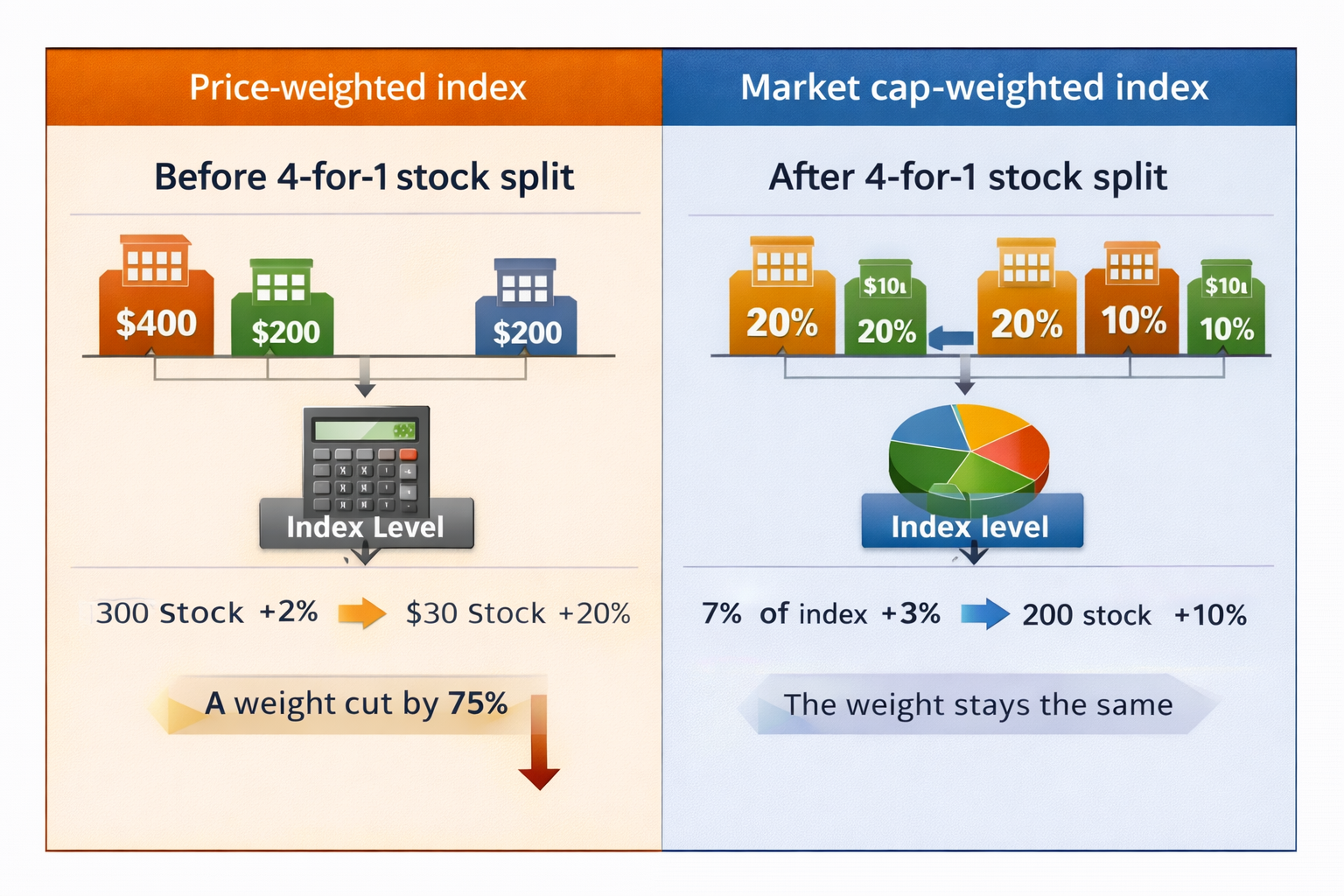
A stock split increases the number of shares while reducing the price per share. Importantly, the company’s total value typically remains relatively stable.
- In a price-weighted stock index, the lower share price immediately reduces the stock’s influence.
- In a market cap-weighted index, the lower price is balanced by more shares, so the influence stays the same.
Equity index methodology specialist: “Stock splits don’t change a company’s value, but they can reshuffle influence in a price-weighted index overnight.”
Example
Two stocks are priced at 400 and 200.
- Before a split, the 400 stock dominates the index.
- After a 4-for-1 split, its price falls to 100, and its influence drops sharply.
This explains why leadership can suddenly change in price-weighted indices even when nothing fundamental has changed about the business itself.
How do news and macro data move indices?
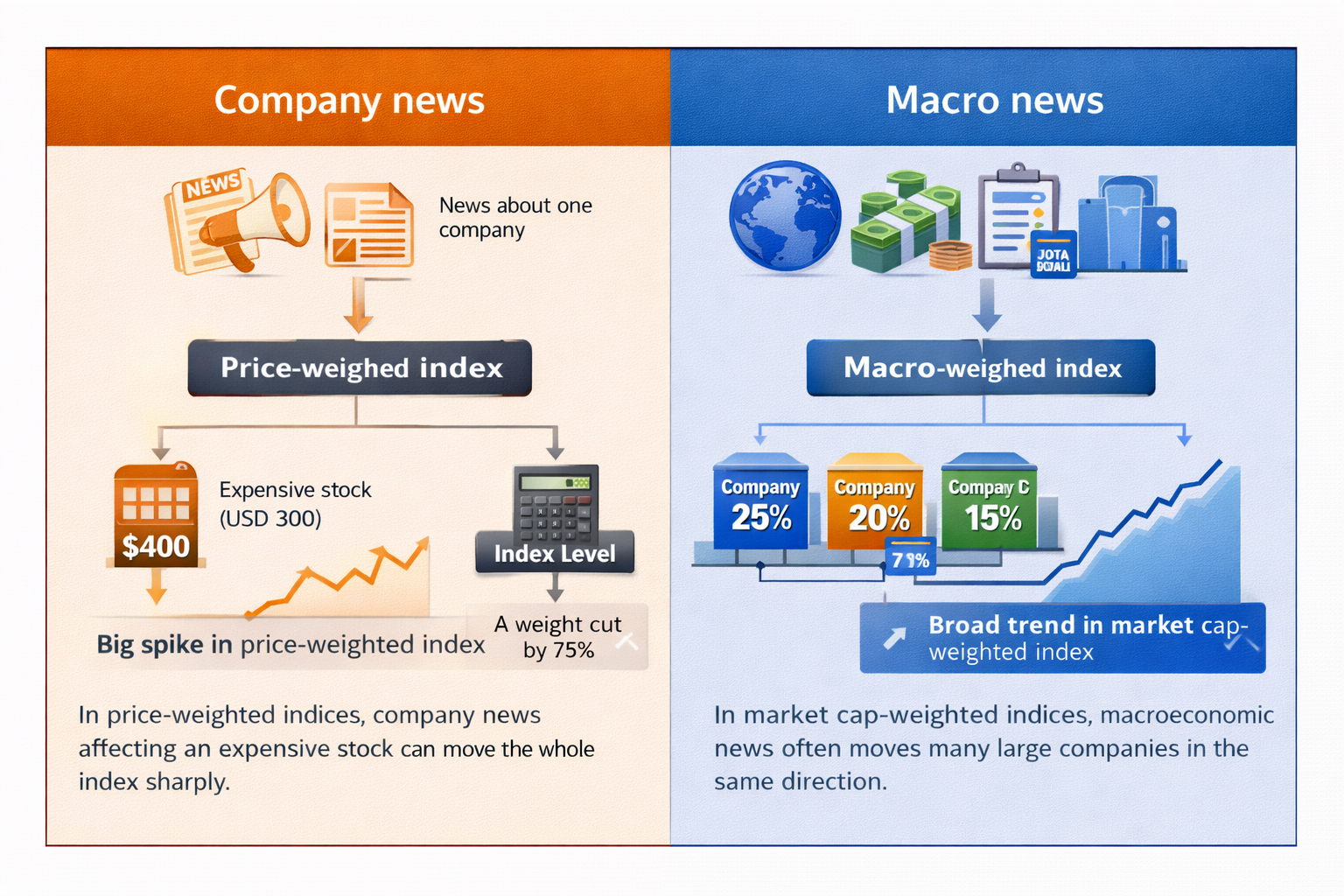
News affects stock indices through the stocks that carry the most influence at that moment.
Company news
- In price-weighted indices, news affecting an expensive stock can move the whole index on its own.
- In market cap-weighted indices, news affecting a very large company can dominate index movement.
This is why earnings reports from one well-known company can sometimes feel more important than broader market conditions.
Global macro strategist: “Macro news rarely affects all companies equally. The biggest companies usually react first.”
Macro news
Interest rates, inflation, and jobs data often affect the largest companies the most. When several large companies react in the same direction, market cap-weighted indices tend to move more smoothly and form clearer trends.
For beginners, the key takeaway is that not all news has the same reach. Company-specific headlines tend to create sudden, sharp reactions, while macro news often sets the direction for days or weeks.
Understanding whether the market is reacting to one company or to wider economic forces makes index movements feel less random and helps new traders avoid overreacting to short-term noise.
Price-weighted vs cap-weighted: What’s different?
- Price-weighted example: The Dow Jones Industrial Average, where high-priced stocks can have an outsized influence.
- Market cap-weighted example: The S&P 500, where the largest companies matter most.
These differences explain why two well-known indices can disagree on the same day, even though both are described as tracking the same market.
How to trade price-weighted stock indices?

When price-weighted indices may suit beginners
- One expensive stock is clearly driving the market.
- You prefer short, focused trades with clear reasons.
- You are comfortable keeping position sizes small.
Price-weighted indices can be useful for learning how leadership concentration affects index behaviour, provided traders remain aware of the associated risks. When a single stock is in the spotlight, its impact is more easily discernible.
When market cap-weighted indices may feel more straightforward to observe
- Several large companies are moving together.
- The market appears less erratic and more directional.
- You prefer fewer sudden jumps.
Because influence is spread across many companies, market cap-weighted indices often feel more consistent in behaviour at times for beginners.
Deriv trading educator: “There’s no better index in general. What matters is whether the index matches what’s driving the market today.”
A beginner’s checklist
- Which stocks matter most today?
- Is movement coming from one name or many?
- Can I keep my position size small enough to stay calm?
How are market cap-weighted indices explained?
Market cap-weighted stock indices usually feel smoother because the influence is spread across several large companies.
Many beginners use these indices as a starting point because movements often align more closely with overall market confidence. When sentiment improves, prices tend to rise steadily; when confidence fades, declines are usually broader and easier to recognise.
This does not mean they are risk-free, but their behaviour can be easier to observe and learn from compared with indices driven by a single high-priced stock.
Common beginner mistakes
- Treating all indices as if they behave the same.
- Ignoring which stocks actually move the index.
- Using position sizes that feel uncomfortable.
- Trading during major news without a clear plan.
Quiz
Which type of index gives more influence to companies with higher market value rather than just higher stock prices?
FAQs