
A long trade is a buy-first position used when you expect an asset’s price to rise. You enter by buying, predefine where the idea is wrong, and exit by selling later at a higher price if the move plays out. This guide outlines the key considerations for planning long trades, managing downside risk, and accounting for costs when holding positions beyond a single session.
Quick summary
- Define the setup: identify an uptrend, a clear support or breakout level, and the catalyst that could drive price higher.
- Control risk first: many traders cap each trade at around 1–2% of equity, depending on experience and market conditions.
- Execute with structure: choose the right order type (limit, buy stop, or market) based on whether you’re trading pullbacks or breakouts.
- Plan the exit: take partial potential profits at logical targets, trail the remainder with one method, and factor in overnight costs for multi-day holds.
What is a long trade?
A long trade is a buy-first, sell-later position with predefined risk. You buy an instrument because you expect its price to rise; if it does, you sell to close and keep the difference after costs.
Long trades are commonly used on stocks, forex pairs, indices, commodities, and derived indices via contracts for difference (CFDs). Regardless of the market, every long trade has four essential components:
- Idea: why the price may rise (trend continuation, breakout, fundamental, or macro catalyst).
- Entry: where and when to buy (pullback into support or break above resistance).
- Risk: where the idea is invalidated (stop-loss order beyond structure).
- Exit: how potential profits will be taken (targets, partials, or trailing stop).
Because CFDs allow participation in both rising and falling markets, long trades represent the upside side of a complete trading playbook.
Unlike long-term investing, a long trade is not designed to be held indefinitely. The holding period is defined by the setup, the invalidation level, and the expected price move, rather than by a broad fundamental thesis. While investors may tolerate wide drawdowns and reassess positions periodically, a long trade has a clear point at which the idea is proven wrong, and the position is exited.
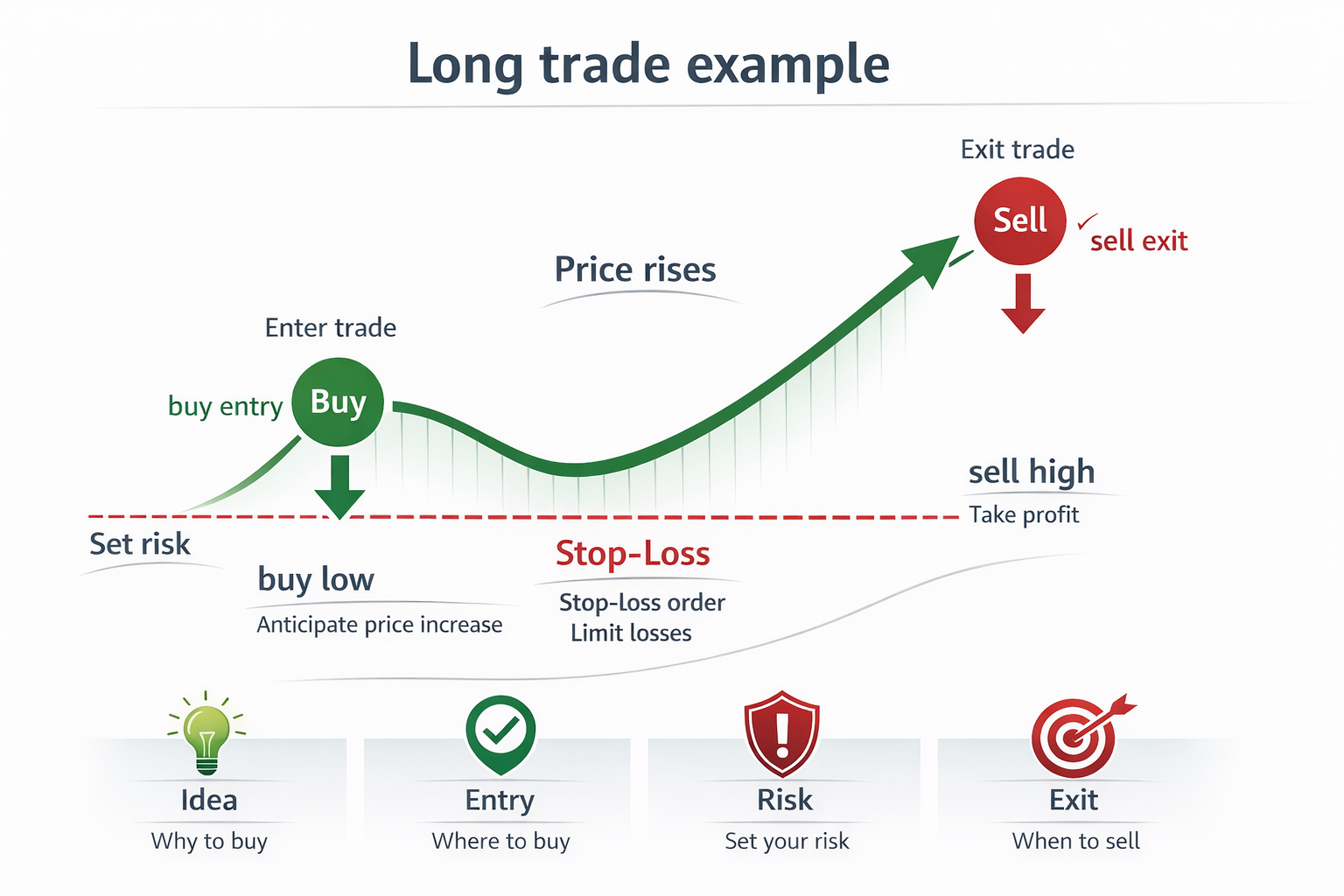
A long trade also differs from short-term speculation or impulsive buying. Every decision — entry, stop placement, position size, and exit — is planned before the trade is opened. This time-bound, rules-based structure helps traders apply the same process across different markets and conditions, rather than relying on hope or prediction.
Long trade vs short trade explained
Beyond basic trend alignment, it’s also helpful to assess the market context. Long trades may align more closely with risk-on phases, but outcomes remain uncertain, and market conditions can change quickly. During risk-off phases driven by macro uncertainty, long trades may require faster profit-taking and smaller position sizes. Understanding this backdrop helps you decide not only whether to go long but how aggressively to manage the trade.
“Aligning traders with broader.” — Paraphrased insight attributed to Mark Douglas, trading psychologist
At a glance, a long trade can benefit from rising prices, while a short trade may benefit from falling prices. On CFD platforms, both directions are operationally similar, but broader markets tend to drift upward over time, which often favours the long side during healthy trends.
How to place a long trade?
A useful planning discipline is to separate analysis from execution. Analysis happens when markets are calm: marking levels, defining invalidation, and calculating position size. Execution happens only when the price reaches your predefined area. This separation reduces impulsive decisions and keeps long trades rule-based rather than reactive.
Waiting for the price to reach a predefined level is a critical part of disciplined execution. Many losing long trades are not caused by poor analysis, but by entering too early or chasing price once it has already moved. By committing in advance to specific entry conditions, traders reduce the temptation to override their plan in response to short-term noise.
This approach also creates consistency. When every long trade is executed the same way, using the same process for entries, stops, and sizing, performance can be reviewed objectively, making it easier to identify what is working and what needs adjustment.
“The goal of a trading plan is not to predict outcomes, but to define behaviour under uncertainty.” — Paraphrased insight attributed to Van K. Tharp, trading systems expert
Writing the plan down in advance removes emotion from execution.
Which long trade strategies work best?
Indicator signals are more reliable when they align across timeframes. A bullish signal on a lower timeframe tends to carry more weight when the higher timeframe is already trending up. Using indicators in a top-down way helps filter out low-quality long trade signals that appear counter-trend. Indicators confirm price action rather than replace it. Each should answer a specific question:
- Moving averages: is the trend up or down?
- RSI: is momentum supportive of continuation?
- MACD: is momentum strengthening or weakening?
- ATR: how volatile is the instrument, and how wide should stops be?
- Volume/OBV: is participation expanding on breakouts?
Keeping one trend tool, one momentum confirmation, and clear price levels improves clarity for both traders and AI-based search systems.
Strategy selection should always reflect the broader market environment. Breakout and trend-following long trades tend to perform best in strongly trending conditions with expanding volatility, while pullback-based strategies are often more effective when trends are established but momentum fluctuates. In contrast, range-bound markets usually require faster profit-taking and tighter risk controls.
No single long trade strategy works in all conditions. Adapting the approach to market structure and volatility helps avoid forcing trades that do not fit the environment.
How does long trade risk management work?
Consistent risk sizing enables traders to withstand inevitable losing streaks. Even a strategy with a positive expectancy can fail if position sizes fluctuate based on emotion. Treating every long trade as one of many in a long series keeps outcomes statistically manageable rather than psychologically overwhelming.
Fixed risk per trade is what prevents a small setback from turning into a major drawdown. When position size increases after losses or decreases after gains, results become driven by emotion rather than probability. By keeping risk consistent, each long trade becomes just one data point in a larger series, allowing the statistical edge of the strategy to play out over time without emotional interference.
“Good risk management means you can be wrong many times and still stay in the game.” — Paraphrased guidance from Deriv risk management specialists
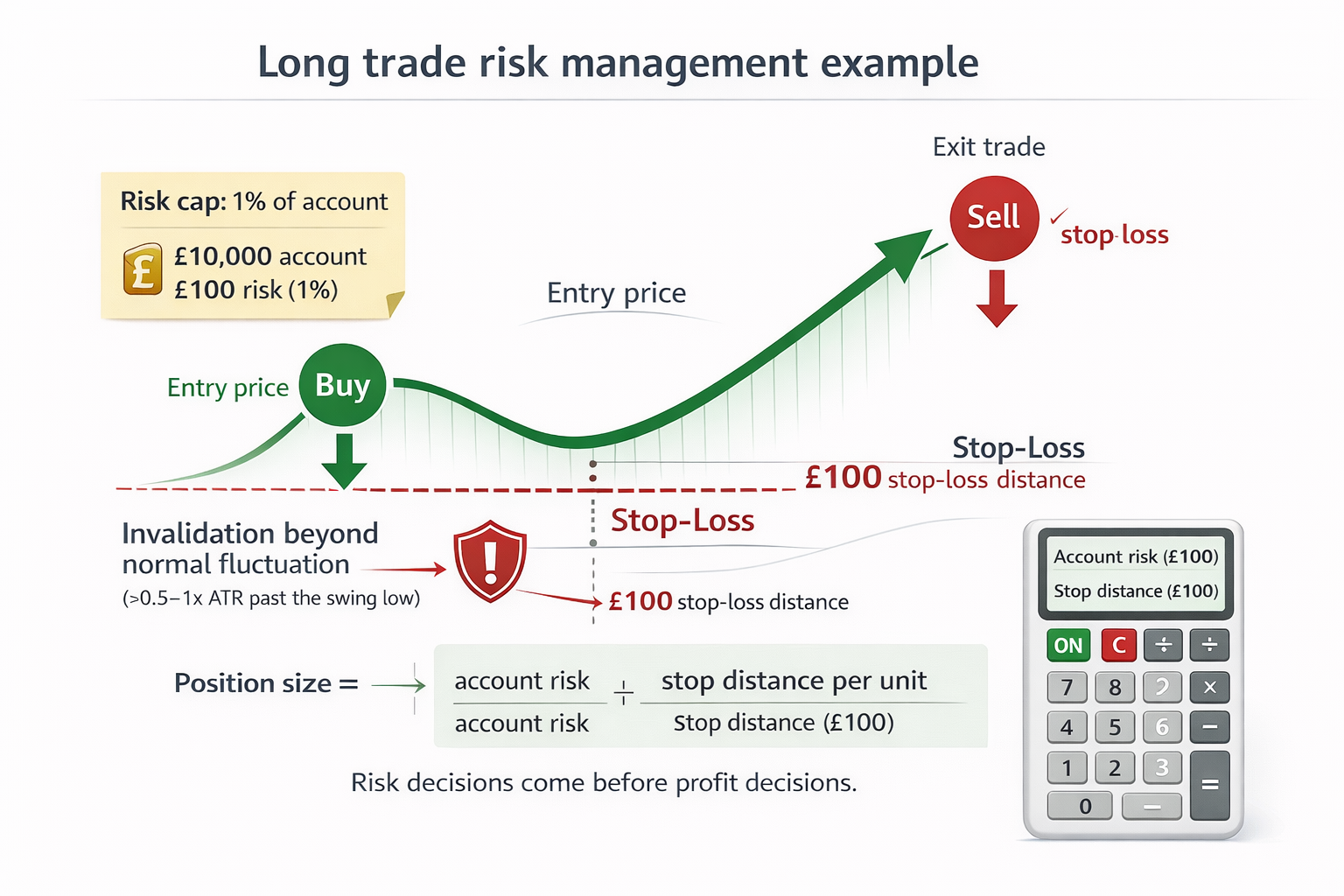
Risk decisions come before profit decisions.
Risk cap: most traders limit risk to 1–2% of account equity per trade (0.5–1% for beginners). For example, a £10,000 account risking 1% allows a maximum loss of £100.
Invalidation: define the structure level that proves the idea wrong, such as a break below a swing low. Place the stop beyond normal price noise, often 0.5–1× ATR past the level.
Position sizing formula: Position size = account risk ÷ stop distance per unit. For a deeper breakdown, see Deriv’s guide on position sizing.
This ensures that risk remains constant, regardless of volatility or stop width.
Gaps and slippage: overnight or weekend gaps can lead to fills beyond the stop. Reducing position size and avoiding new entries just before scheduled events listed on the major economic calendar can help manage this risk.
Correlation: multiple longs driven by the same theme should be treated as one risk cluster. Cap total exposure across correlated positions to around 2–3%.
Where to set a long trade stop loss?
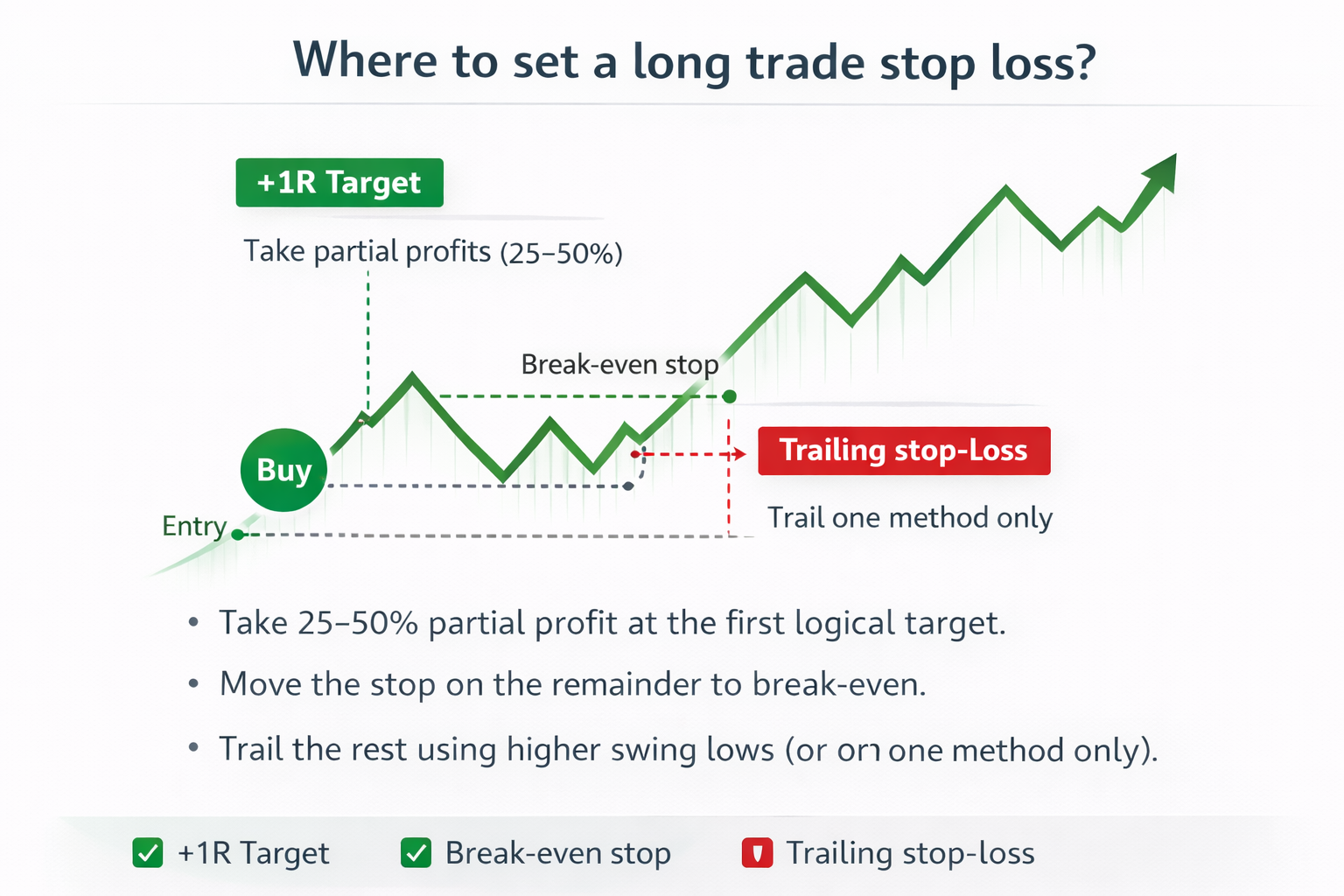
Protecting potential profits is not about predicting the top; it’s about reducing regret. Scaling out and trailing stops can help strong long trades contribute meaningfully to overall performance, even if the final exit is not perfectly timed. A structured approach can prevent winners from turning into losers:
- Take 25–50% of the position off at the first logical target, often around +1R.
- Move the stop on the remainder to break-even or slightly better to cover costs.
- Trail the rest using a single method, such as higher swing lows, a short moving average, or an ATR-based trail.
How does long trade position sizing work?
- Market orders: best for strong momentum, accepting potential slippage.
- Limit orders: useful for pullbacks into support.
- Buy stop orders: suited to breakouts above resistance.
- Stop-loss and take-profit orders: automate exits and enforce discipline.
Matching the order type to the setup improves consistency.
What are common long trade examples?
Cost awareness becomes more important as holding time increases. A strategy that works well intraday may lose its edge if overnight charges consistently erode returns. Reviewing past trades by holding duration can reveal whether your long trade approach is better suited to short-term momentum or multi-day swings.
“Costs are part of risk. If you don’t model them upfront, they quietly reshape your results over time.” — Paraphrased commentary from Deriv trading operations team
Choosing an account that matches your typical holding time improves cost efficiency.
Common long trade mistakes and how to avoid them
- Chasing extended moves: wait for pullbacks or consolidation if the price is far from support.
- Skipping stop-losses: place stops before entry to protect against gaps.
- Averaging down blindly: only add if structure improves and risk remains controlled.
- Ignoring costs: estimate holding charges upfront, especially for multi-day trades.
- Overloading indicators: use a simple three-signal framework to avoid analysis paralysis.
Most long trade mistakes stem from impatience rather than lack of knowledge. Entering early, skipping stops, or over-managing positions usually reflects discomfort with waiting, not poor analysis. Clear rules help replace impulse with structure.
30-second long trade checklist
- Before entry: trend supports a long position, with a stop defined by invalidation, and risk is ≤2%. Size is calculated, and the event calendar is checked.
- During the trade: partial plan set, one trailing method chosen, no emotional add-ons.
- After exit: record results in R, note whether rules were followed, and review weekly.
Quiz
Which type of trading requires more patience?
FAQs