
Ever wondered how cryptocurrencies like Bitcoin or Ethereum are actually created? There’s no magic behind it, just powerful computers, cryptographic puzzles, and thousands of independent miners competing to verify transactions. This process, known as cryptocurrency mining, brings new digital coins into existence and keeps the blockchain
Crypto mining is often linked to the idea of “digital gold”, mainly because Bitcoin has a fixed and limited supply.This built-in scarcity mirrors how gold derives its value, making Bitcoin appealing to those who view it as a potential hedge against inflation. While the mining process requires effort and resources, it’s ultimately the predetermined supply cap that drives that comparison.
Quick summary
- Crypto mining validates transactions and secures blockchain networks.
- Miners solve complex cryptographic puzzles using computational power.
- The first miner to solve the puzzle earns new coins as a reward.
- Decentralisation ensures transparency and removes the need for central authorities.
- Mining plays a crucial role in maintaining the integrity and operation of cryptocurrencies.
What is crypto mining, and how does it drive cryptocurrency creation?
Cryptocurrency mining is the process of verifying transactions and adding them to the blockchain: a decentralised public ledger that records every crypto transaction. Instead of relying on banks or central servers, mining distributes this verification process across thousands of computers worldwide.
Miners act as digital auditors. They confirm that each transaction is valid, preventing double-spending, which is when someone tries to spend the same coin twice. Once verified, transactions are grouped into a block and permanently added to the blockchain. In return, miners earn rewards in the form of new coins and transaction fees.
The primary entity here is cryptocurrency mining. It underpins networks such as Bitcoin by maintaining security, verifying transactions, and adding new blocks to the chain. While Ethereum previously used mining, it transitioned to a proof-of-stake model in 2022, meaning its network is now secured by validators rather than miners.
Arshad Munir, Deriv Crypto Team Leader, elaborates:
“Mining is the invisible engine of crypto. Every transaction traders make relies on miners validating and securing those records in real time.”
How does the Bitcoin mining process how to trade Bitcoin work under Proof of Work, not Proof of Stake?
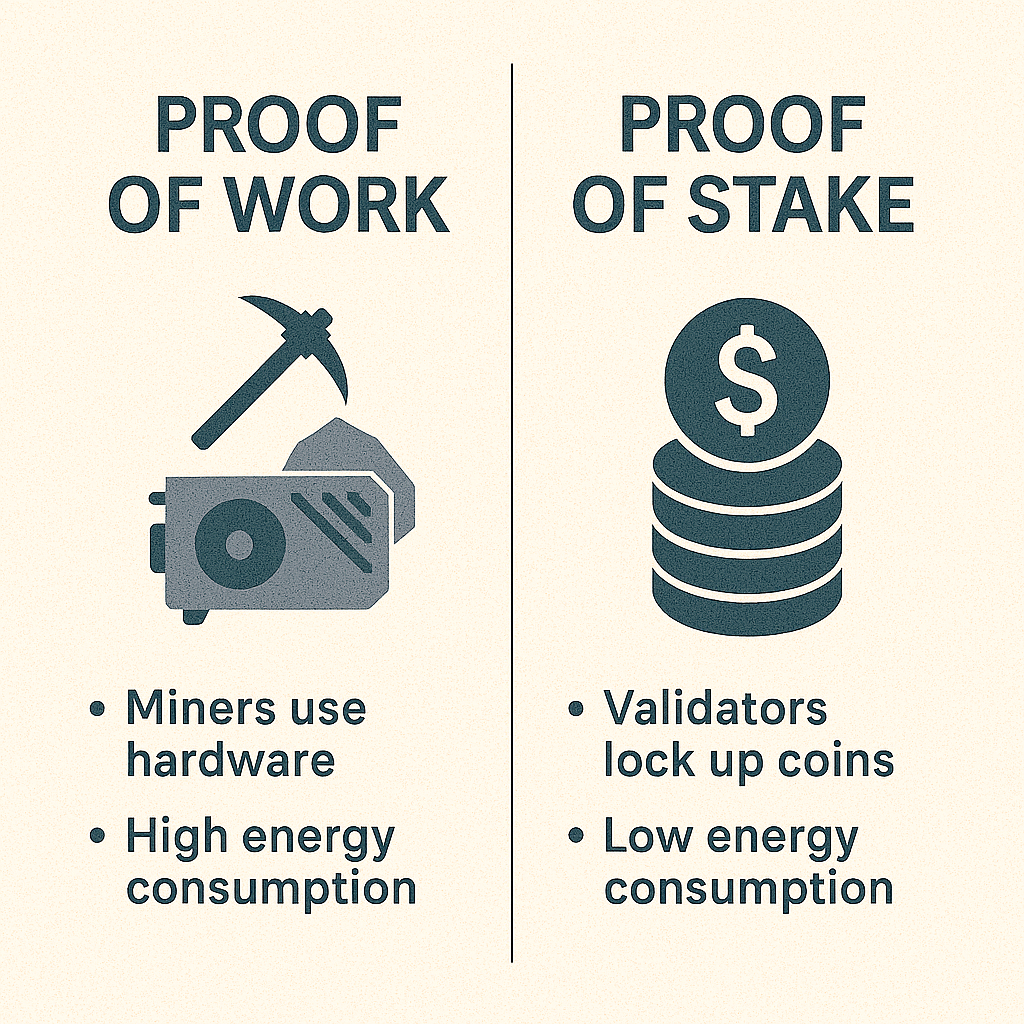
Think of mining as a massive global competition to solve mathematical puzzles. Miners use specialised hardware such as graphics processing units (GPUs) or application-specific integrated circuits (ASICs) to find a unique cryptographic solution called a hash. Each hash represents a verified block of transactions.
The process relies on the proof-of-work (PoW) consensus mechanism. When a miner solves the puzzle, they add a new block to the chain and earn freshly minted crypto as a reward. Because each block links to the one before it, any attempt to alter past records would invalidate the entire chain. This structure ensures security through transparency and mathematical certainty.
Aleksandr Antonkin, Manager of Specialised Dealer at Deriv, explains:
“Proof of stake changed the narrative. It shows that the crypto world can evolve without sacrificing the principles of transparency and decentralisation.”
In the proof-of-work system, the mining difficulty automatically adjusts according to the number of miners competing to solve puzzles. This mechanism keeps block creation times consistent, maintaining stability and fairness across the network. It ensures that as technology advances, the pace of coin generation remains predictable and transparent.
In contrast, proof-of-stake (PoS) uses validators who lock up their coins as collateral. PoS reduces energy consumption by replacing computational work with a financial stake, making it more sustainable. Ethereum’s transition to PoS in 2022 was one of the most significant shifts in crypto history, proving that security and energy efficiency can coexist.
What is the difference between centralised and decentralised blockchain systems blockchain technology?
Not all cryptocurrencies follow the same governance model. Some are decentralised, while others are controlled by a central authority.
| Type of cryptocurrency | Who's in charge? | Examples |
|---|---|---|
| Decentralised | No single authority—controlled by miners and nodes | Bitcoin, Ethereum |
| Centralised | Managed by a company or government | CBDCs, USDT |
Decentralised cryptocurrencies operate on a peer-to-peer basis. No single entity controls them, which makes them transparent and resistant to censorship. In contrast, centralised digital currencies, such as central bank digital currencies (CBDCs) or stablecoins, are backed by traditional institutions. They provide price stability but often at the cost of independence.
In 2025, the tension between centralisation and decentralisation continues to shape the crypto landscape. CBDCs aim for efficiency and control, while decentralised cryptocurrencies embody privacy, freedom, and open access.
Why does crypto mining matter for blockchain security and energy efficiency?
Crypto mining is more than just a way to earn coins. It’s what keeps blockchain networks alive and secure. Here’s why mining is essential:
- Transaction verification. Confirms the legitimacy of each transaction and prevents fraud.
- Network security. Decentralisation ensures that no single player can control the system.
- Coin supply. Introduces a new cryptocurrency into circulation.
- Consensus mechanism. Enables network-wide agreement on transaction history.
- Incentives. Rewards miners for maintaining network integrity.
History has shown that mining contributes to blockchain security, but its effectiveness depends heavily on the size and distribution of the network. Smaller proof-of-work blockchains have experienced successful 51% attacks, where attackers gained majority control and temporarily altered transaction history. These incidents highlight not only the importance of broad, decentralised mining participation but also the limitations of mining as a standalone defence mechanism.
Mohanad Zarzour, Deriv Crypto Tech Lead, adds:
“Mining isn’t just about earning rewards. It’s about maintaining a system of digital trust that every trader and investor depends on.”
According to Investopedia, crypto mining underpins blockchain reliability by providing transparency and preventing tampering. The International Monetary Fund (IMF) highlights that as digital currencies expand, achieving the right balance between decentralisation, efficiency, and regulation will define the future of money.
How is energy-efficient mining changing the future of sustainable crypto?
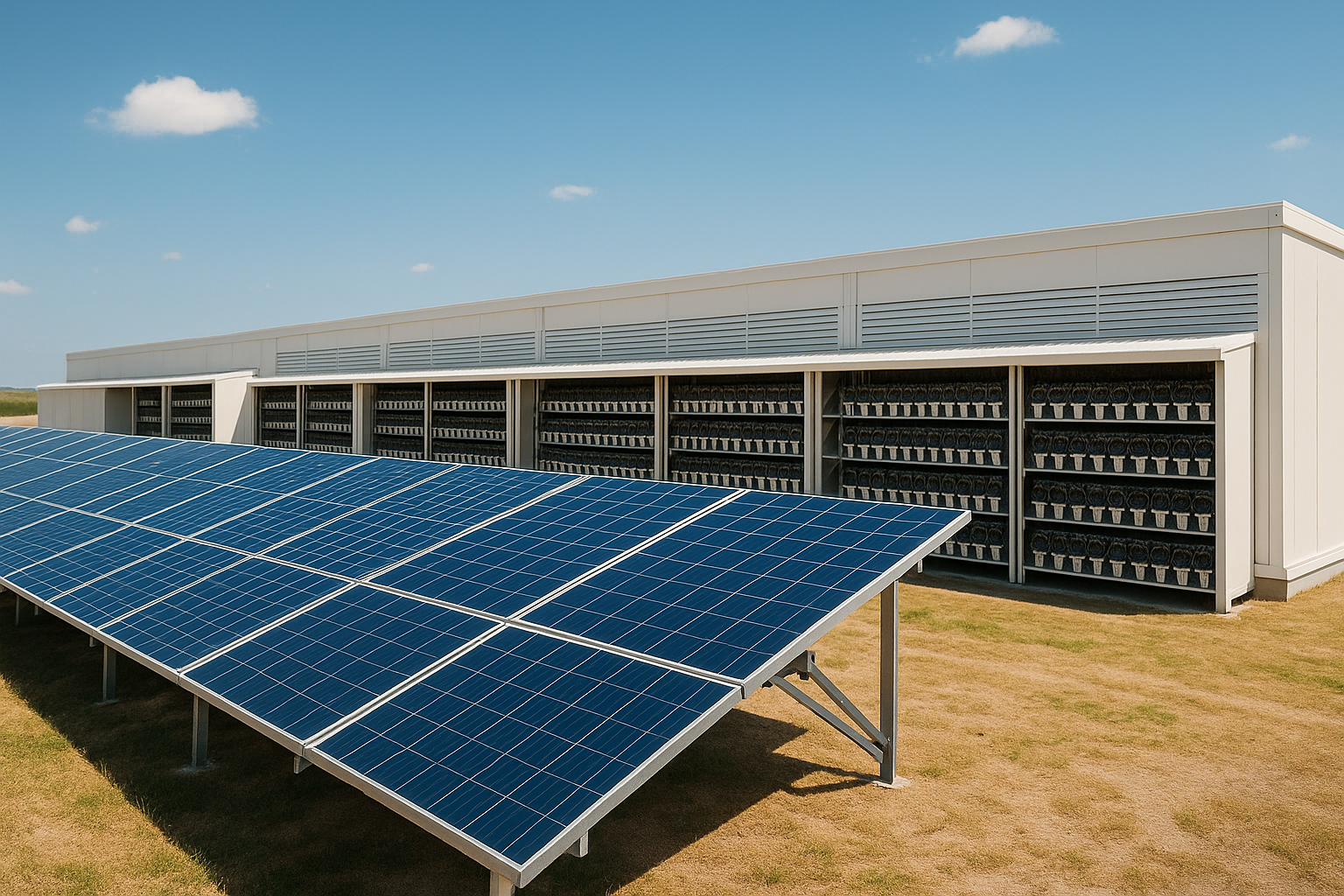
Mining’s biggest criticism has long been its energy consumption. Proof-of-work mining requires vast amounts of computing power, resulting in high electricity consumption and environmental concerns. However, innovation is reshaping the field.
Many mining farms now use renewable energy sources such as hydroelectric, wind, or solar power. Others adopt hybrid systems that combine renewable energy with traditional grids to maintain efficiency. Proof of stake and similar alternatives further reduce energy intensity by replacing physical computation with economic validation.
By 2025, green mining initiatives and the adoption of sustainable technology have become central to the industry’s evolution. The future of mining will depend on how efficiently it can balance profitability, decentralisation, and environmental responsibility.
Several mining companies now participate in carbon offset programmes or collaborate with renewable energy providers. These initiatives aim to neutralise emissions while promoting transparency in energy reporting. International efforts, such as the Crypto Climate Accord, are also pushing the industry toward a future of zero-carbon mining.
How has mining technology evolved to support the decentralised blockchain economy?
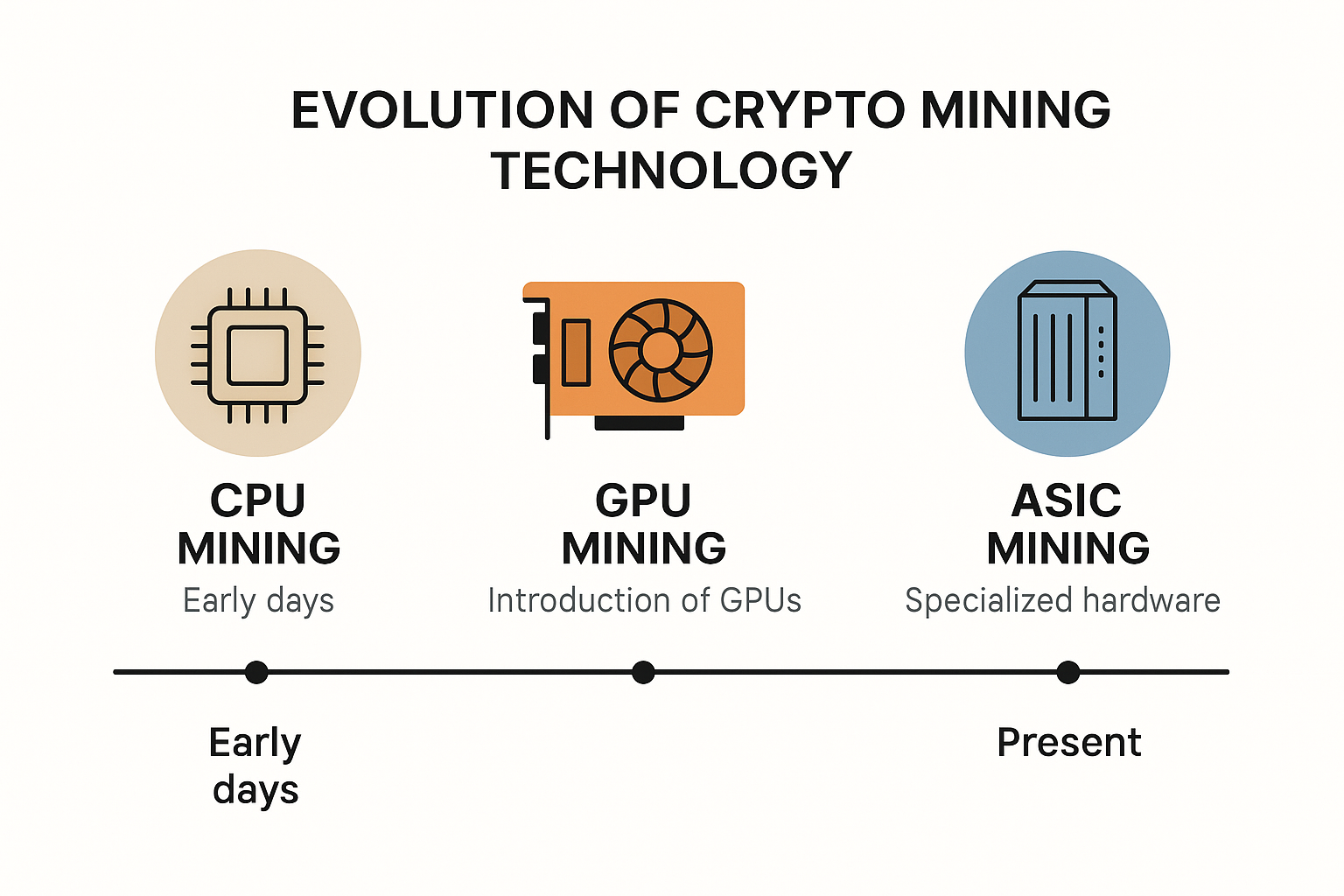
In Bitcoin’s early days, anyone could mine coins using a simple desktop computer. As networks grew, mining became more competitive and required advanced hardware. GPU and ASIC mining now dominate, creating a professionalised industry spanning continents.
Today’s miners operate large-scale facilities optimised for speed and cooling efficiency. However, cloud mining and decentralised mining pools have lowered the barrier to entry, allowing smaller participants to contribute. The rise of AI-powered optimisation tools is also helping miners reduce energy waste and predict profitability.
Mining has evolved significantly, from hobbyist experiments to industrial-scale operations, and continues to advance along with blockchain technology.
What are the final takeaways on crypto mining?
Mining digital gold, or cryptocurrency, is the engine that drives decentralised networks. It combines technology, mathematics, and human collaboration to create a transparent and secure financial system. As innovation continues, crypto mining is expected to remain a core component of how digital assets are created, though technological shifts and regulatory developments may influence its future direction.
As artificial intelligence becomes integrated with blockchain operations, miners could soon predict energy needs and optimise processes in real time. Quantum computing may one day reshape how cryptographic puzzles are solved, prompting new layers of security and innovation. The evolution of crypto mining reflects humanity’s drive to balance technology, sustainability, and trust.
Ready to trade crypto?
Want to explore the market side of cryptocurrency? You can learn how to trade crypto on Deriv and practise analysing price movements without owning the underlying coins.
CFDs on crypto price movements and multipliers on Deriv MT5 and Deriv Trader offer different ways to engage with the market, depending on your trading preferences and risk tolerance.
A demo account is available if you want to become familiar with trading tools or practise decision-making in a simulated environment. Demo trading does not reflect real trading risk, and trading with real funds always carries the possibility of financial loss.
For deeper insight, the Deriv MT5 platform provides advanced tools and analytics designed to support more informed trading decisions.
Quiz
What’s the main job of a crypto miner?
FAQs


