
Swing trading in stocks is a medium-term trading approach where positions remain open for several days or weeks to capture market movements that unfold over time. It sits between the pace of day trading and the long-term perspective of investing, giving traders the chance to participate in trends without constant screen-watching. Although it offers flexibility, outcomes remain uncertain, and traders must carefully manage risk.
Quick summary
- Swing trading involves holding trades for several days or weeks.
- Traders use indicators, chart patterns, and fundamental triggers to build trade ideas.
- Overnight gaps and financing costs can impact positions and must be factored into planning.
- Effective setups combine trend structure, support and resistance, and risk control.
- Deriv platforms such as Deriv MT5 and Deriv cTrader provide tools that help traders analyse markets and manage trades responsibly.
What is a swing trading strategy?
Swing trading balances timing with patience. While day traders look for minute-by-minute opportunities, swing traders focus on movements that develop over multiple sessions. Traders review broader market conditions, such as sector trends, volatility cycles, and earnings seasons, to anticipate where pressure or momentum might build—while recognising that price behaviour can shift unexpectedly.
Dr. Lena Moritz, Market Behaviour Researcher suggests:
“Swing trading works best when traders view markets as sequences of impulses and pauses. Recognising this rhythm helps them avoid chasing noise and focus on meaningful movement.”
Traders often combine technical and fundamental information. For example, increased volatility around earnings announcements can create short- to medium-term opportunities, but it also increases risk. Swing traders must therefore weigh potential reward against exposure to uncertain moves.
Swing traders typically analyse:
- Technical indicators such as moving averages, Relative Strength Index (RSI), Moving Average Convergence Divergence (MACD), and Average True Range (ATR)
- Price action patterns, including pullbacks, breakouts, and reversals
- Fundamental catalysts like news releases, economic reports, or company results
Because trades remain open overnight, prices can gap higher or lower due to the release of new information. As Jonathan Hale, a portfolio strategist at Apex Investments, notes: “Overnight gaps can redefine risk instantly, which is why swing traders rely heavily on volatility buffers and disciplined stop placement.” Traders also factor in overnight financing charges, which vary by asset and account type.
Which swing trading indicators matter most technical indicators?
Indicators help traders interpret momentum, trend direction, and volatility, but no single tool can predict outcomes. Swing traders blend signals from multiple sources and compare them with chart structure.
Trend indicators, such as moving averages, help traders understand whether price is broadly rising or falling. Momentum indicators, like RSI and MACD, provide information about the strength or weakness of a move. Volatility measures such as ATR help traders place stop-loss levels that account for normal price movement.
Omar Villareal, Senior Technical Analyst, explains:
“Indicators should confirm what price is already suggesting. When price and indicators disagree, experienced swing traders trust structure first and signals second.”
A key principle is confluence: when several pieces of information point in the same direction. For example, a bullish RSI divergence near a support level may strengthen a trader’s confidence, though it does not remove risk. Market conditions can change rapidly, and indicators can give false or conflicting signals.
Swing trading may feel more manageable than intraday trading because it does not require constant monitoring; however, it still demands consistent review, thoughtful planning, and an acceptance that market outcomes are never certain.
What are useful swing trading examples?
Before placing a trade, swing traders typically assess the broader trend on higher timeframes. A trending market often produces clearer setups, while range-bound conditions can create false signals or choppy movement. Traders outline their plans in advance, including entry, stop-loss level, and target areas, to reduce emotional decisions during the trade.
Sophia Tan, Deriv trading strategist elaborates:
“The strongest swing setups occur where multiple forms of evidence align — structure, momentum, volatility, and context. Confluence is what turns a good idea into a reliable trade.”
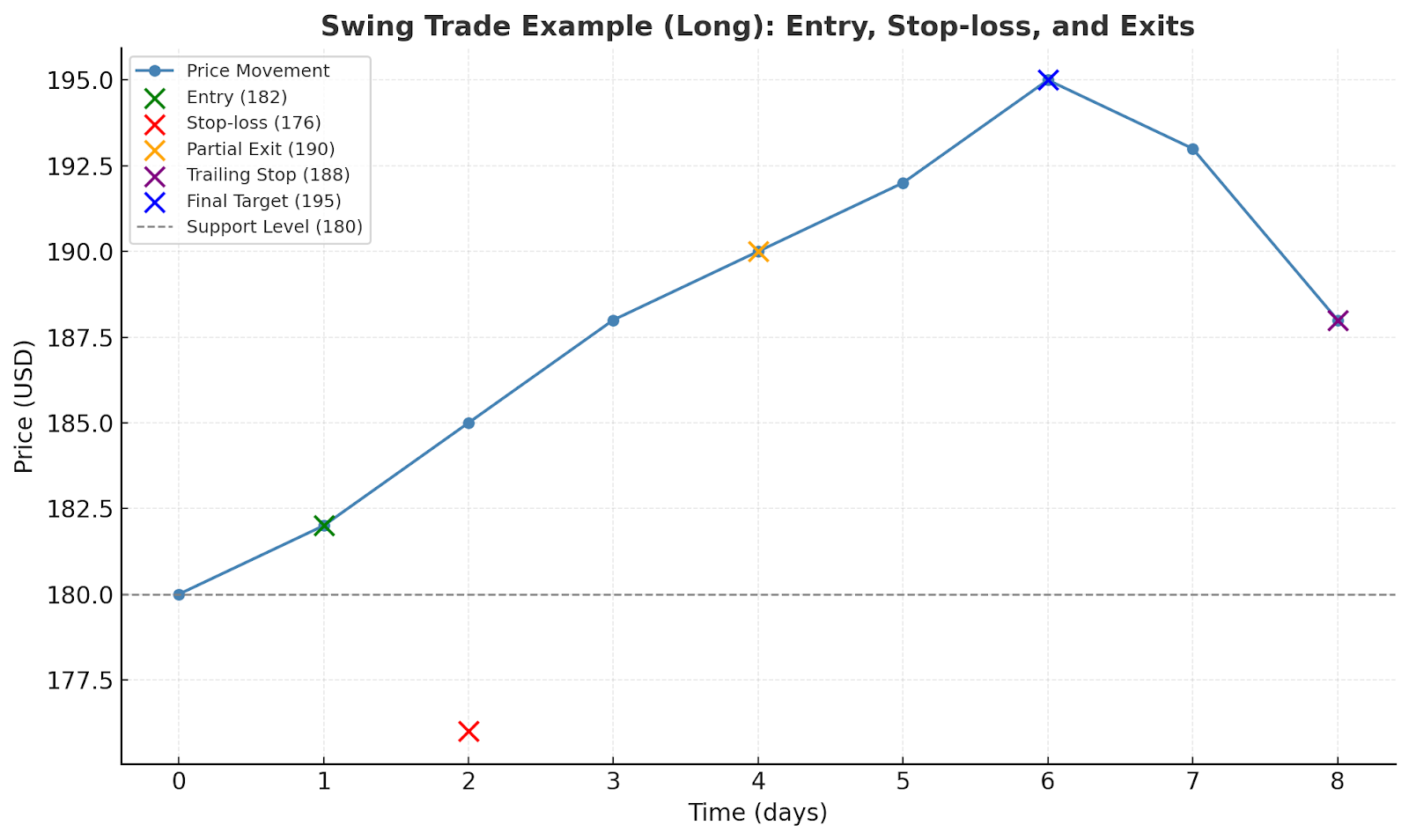
Example: Long trade setup
- Entry: Apple stock pulls back to support at USD 180.
- Signal: A bullish pattern forms on the H4 chart.
- Entry price: USD 182
- Stop-loss: Below support at USD 176
- Partial exit: At USD 190
- Trailing stop: Adjusted to USD 188
- Final target: USD 195
Example: Short trade setup
- Entry: Price hits resistance at 195 and begins turning lower
- Sell price: 195
- Stop-loss: 200
- Partial exit: 190
- Trailing stop: 187
- Final target: 182
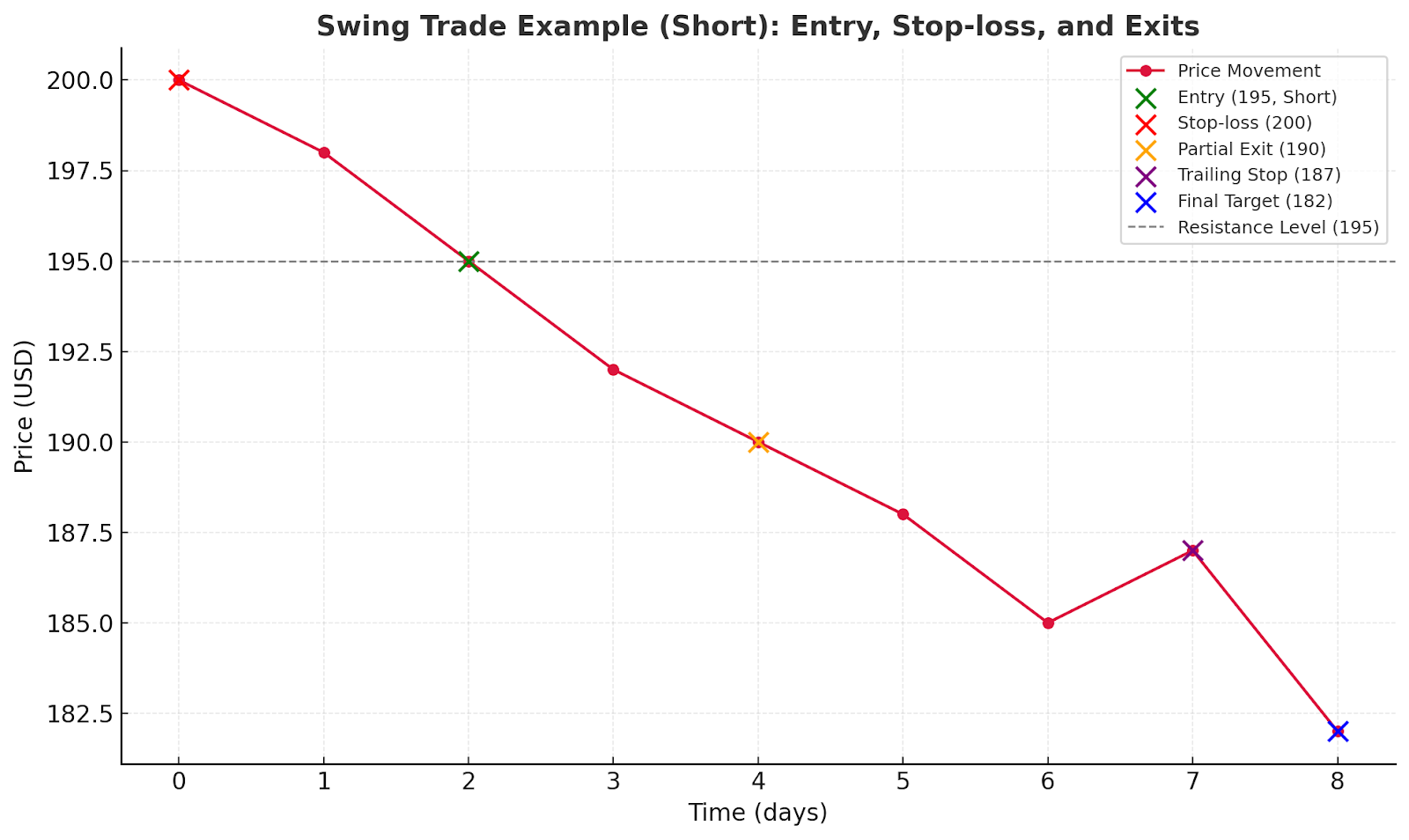
These illustrations show structured approaches to analysis—not guaranteed outcomes. Real trades may unfold differently due to volatility, shifting sentiment, or news events.
How does risk management in swing trading risk management position sizing guide work?
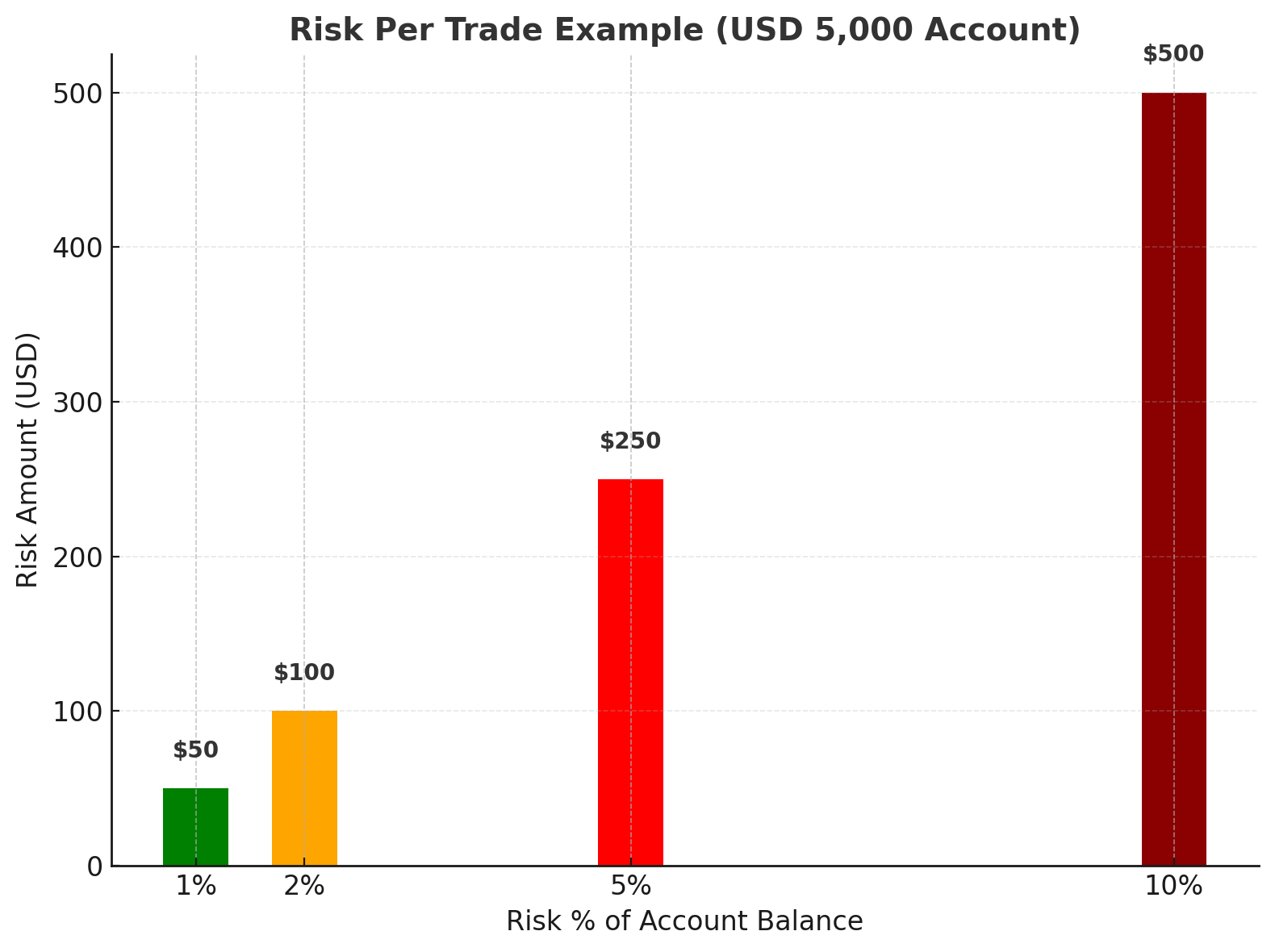
Risk management is central to swing trading because positions remain exposed to overnight and weekend movements. Traders often risk only a small portion of their account—such as 1–2%—to limit the impact of unfavourable price changes.
Volatility assessment is equally important. When markets become more volatile, traders may widen stop-loss distances or reduce position sizes. Some traders set weekly or monthly risk caps to avoid significant drawdowns during unpredictable periods.
Risk Management Specialist, Caleb Hart, elaborates:
“Consistent risk sizing matters more than being right. Even a strong strategy becomes fragile without stable exposure across trades.”
Other factors that influence risk include:
- Economic announcements such as inflation or interest rate releases
- Company earnings that can cause rapid movement in individual stocks
- Financing costs that accumulate while trades remain open
Derived Indices on Deriv operate 24/7, giving traders ways to practise strategies outside traditional market hours. Strong trade management focuses on adapting to changing conditions rather than expecting smooth or predictable movements.
Which swing trading account types suit Deriv swing trading?
Different account types offer different trading conditions:
- Financial account: Suitable for stocks, forex, and commodities.
- Swap-free account: Useful for longer holds or traders following Islamic finance principles.
- Zero Spread account: Helps traders calculate costs precisely, which can be valuable for index trading.
Traders choose accounts based on holding duration, fee structure, risk tolerance, and preferred instruments.
What does swing trading in stocks look like in practice?
On 3 August 2023, Apple reported earnings above expectations. Following the announcement, the stock climbed from around USD 220 to USD 225. A swing trader might construct a trade around this momentum:
- Entry: USD 225
- Stop-loss: USD 215
- Target: USD 240
- Trailing stop: Adjusted upward as price moves
This scenario demonstrates how technical and fundamental elements can align, though actual results depend on market conditions. “Earnings-driven swings often provide clearer multi-day trends than ordinary sessions,” says Nina Leclerc, Deriv’s Equity Products Specialist. “But traders still need defined risk limits before entering any setup.”
Demo accounts with 10,000 USD virtual funds allow new traders to practise without risking real capital.
How beginners can start
New traders often begin by observing how trends and consolidations form across timeframes. Back-testing and journaling help identify patterns in decision-making, including emotional responses and risk preferences.
Over time, beginners explore different swing-trading styles—trend-following, breakout setups, or reversal attempts. Success depends on consistency, realistic expectations, and acceptance that losing trades are part of the process.
Dr. Mira Solberg, a trading psychology lecturer, mentions:
“Beginners improve fastest when they track behaviour, not just profits. Noting emotions during trades teaches more than reviewing charts alone.”
A simple workflow for new traders:
- Scan markets for trending instruments
- Confirm setups using indicators and multi-timeframe charts
- Execute with predefined stops and targets
- Review trades once or twice a day
- Record decisions and observations in a trading journal
Comparison: Swing trading vs day trading vs long-term investing day trading
| Feature | Swing trading | Day trading | Long-term investing |
|---|---|---|---|
| Holding period | Days to weeks | Minutes to hours | Months to years |
| Time commitment | Moderate | High | Low |
| Capital needs | Uses leverage; overnight fees apply | Uses leverage intraday | Full capital, minimal leverage |
| Analysis focus | Technical + event tracking | Short-term chart behaviour | Fundamental and macro factors |
| Best for | Part-time traders | Traders wanting fast-paced setups | Long-horizon portfolios |
Which Deriv account types are suitable for swing trading?
- Financial account: Best for stocks, forex, and commodities.
- Swap-free account: Designed for longer-term holds or Islamic finance.
- Zero Spread account: Suitable for traders who want predictable costs for precise entries.
How to begin swing trading on Deriv
Traders can start on a Deriv demo account with 10,000 USD virtual funds before transitioning to a real account once they feel more confident. Building experience gradually helps traders become familiar with volatility, execution tools, and risk management.
Quiz
What’s a strong signal for a swing trade entry?
FAQs


