
Forex trading is built around currency pairs, which determine how prices are quoted, how trades are structured, and how costs such as spreads are applied in the market understanding trading costs. A forex pair shows how one currency is valued against another, providing the reference point for every price movement and transaction in the foreign exchange market.
Understanding how forex pairs work matters because they influence not only price direction, but also trading costs, volatility, and how market information is interpreted.
This guide explains forex pairs step by step, covering how they are structured, the different types of pairs, how prices move, and how key concepts such as pips, lot sizes, pip value, and spreads are connected. By the end, readers will have a clearer framework for understanding how forex quotes are structured and why currency pairs sit at the centre of forex trading.
Quick summary
- Forex pairs quote the value of one currency against another.
- Each pair consists of a base currency and a quote currency.
- Major, minor, and exotic pairs differ in liquidity, volatility, and spreads.
- Pips, lot sizes, and pip value determine how potential profits and losses are calculated.
- Spreads represent the cost of entering a trade and vary by pair and market conditions.
What is a forex pair?
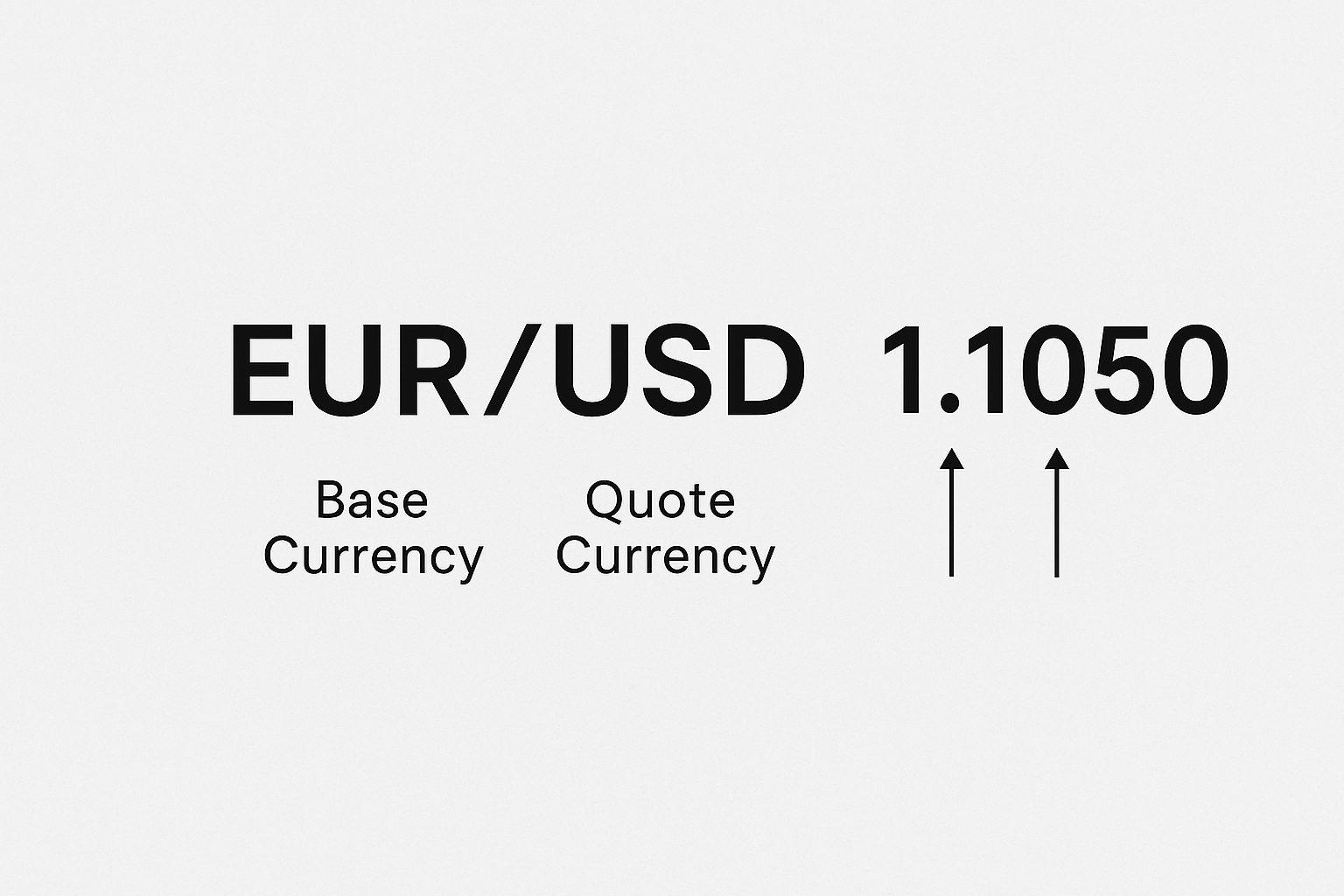
A forex pair consists of two currencies traded against each other, such as EUR/USD (euro versus US dollar) or GBP/JPY (British pound versus Japanese yen). The price of a forex pair shows how much of the second currency is required to buy one unit of the first currency.
For example, if EUR/USD is trading at 1.1050, it means one euro is worth 1.1050 US dollars. Forex prices constantly change as currencies strengthen or weaken based on economic data, interest rates, central bank decisions, and global market sentiment.
Currencies are always quoted in pairs because every transaction involves exchanging one currency for another. When you buy a forex pair, you are buying the base currency and selling the quote currency. When you sell the pair, you are doing the opposite.
How are forex pairs interpreted?
Every forex pair has two key components:
- Base currency: The first currency in the pair. It represents the currency you are buying or selling.
- Quote currency: The second currency in the pair. It shows how much of this currency is needed to buy one unit of the base currency.
Using EUR/USD as an example:
- EUR is the base currency.
- USD is the quote currency.
If EUR/USD rises from 1.1050 to 1.1100, the euro has strengthened against the US dollar. If it falls, the euro has weakened. Understanding this relationship provides context for how price movements are described in the forex market.
Why do forex pairs move?
Forex pairs move because currencies reflect the relative strength of two economies. Several factors influence these movements:
- Interest rates: Higher interest rates tend to attract capital, strengthening a currency.
- Economic data: Employment figures, inflation reports, and GDP growth affect currency demand.
- Central bank policy: Statements and actions from central banks can shift expectations and prices.
- Market sentiment: Risk-on and risk-off behaviour influences which currencies traders prefer.
Because a forex pair compares two currencies, positive news for one currency can move the pair even if it has no impact on the other.
Deriv market analyst: “Forex prices are always relative. When traders understand that every move reflects two economies at once, currency behaviour becomes much easier to interpret.”
What types of currency pairs exist?
Forex pairs are commonly grouped into three categories based on liquidity, trading volume, and market behaviour.
Major pairs
Major pairs include the US dollar and currencies from the world’s largest economies. Examples include EUR/USD, USD/JPY, GBP/USD, and AUD/USD.
Key characteristics of major pairs include:
- High liquidity
- Tighter spreads
- More predictable price behaviour
For beginners, major pairs are commonly used as a starting point due to their higher liquidity and wider availability of market information.
Deriv trading specialist: “Major forex pairs tend to show more consistent liquidity and pricing conditions compared with less-traded pairs.”
Minor pairs
Minor pairs do not include the US dollar but involve other major currencies, such as EUR/GBP, EUR/AUD, or AUD/JPY.
Minor pairs typically have:
- Moderate liquidity
- Slightly wider spreads than majors
- Price movements influenced by multiple economic regions
These pairs can offer diversification but may require closer monitoring.
Exotic pair
| Liquidity | Example currency pairs | ||
|---|---|---|---|
| MAJOR | High | Low | EUR/USD USD/JPY |
| MINOR | Medium | Medium | EUR/GBP AUD/JPY |
| EXOTIC | Low | High | USD/TRY GBP/MXN |
Exotic pairs combine a major currency with a currency from an emerging market, such as USD/TRY or GBP/MXN. These pairs are less liquid and tend to be more volatile.
Characteristics of exotic pairs include:
- Wider spreads
- Higher volatility
- Increased sensitivity to political and economic instability
Exotic pairs are generally less suitable for beginners due to their higher trading costs and associated risks.
How are forex pairs typically chosen by beginners?
When starting out, selecting the right forex pairs is as important as understanding how they work. Beginners often start by focusing on:
- Liquidity: Highly traded pairs typically have higher liquidity, which affects how trades are entered and exited.
- Spreads: Lower spreads reduce trading costs.
- Volatility: Moderate price movement is easier to manage than extreme swings.
- Trading sessions: Some pairs move more during specific market hours.
Major pairs often meet these criteria, making them a practical starting point for new traders.
What are pips in forex trading?
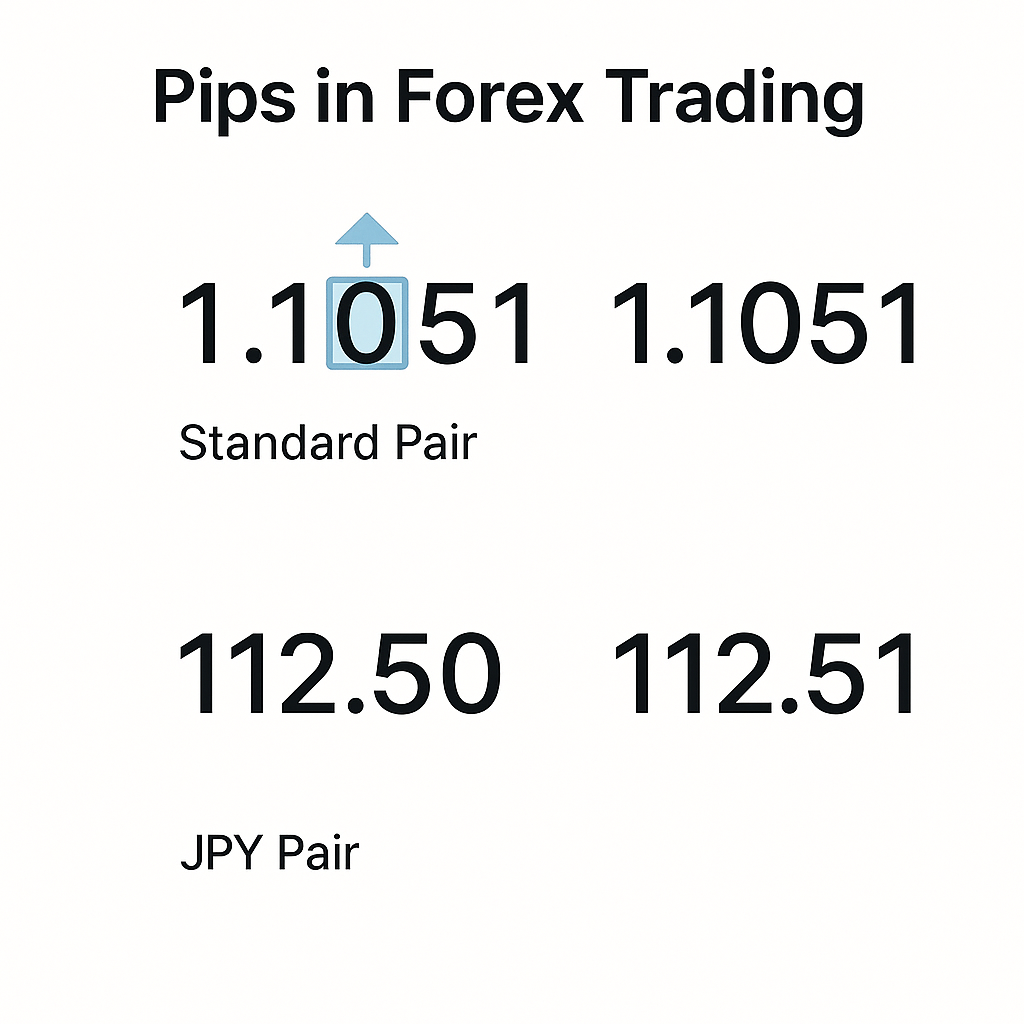
A pip (percentage in point) is the smallest standard price movement in a forex pair. For most pairs, a pip is the fourth decimal place. For example, a move from 1.1050 to 1.1051 equals one pip.
For pairs involving the Japanese yen, a pip is typically the second decimal place. For instance, a move from 112.50 to 112.51 represents one pip.
Pips provide a standardised way to measure price changes, allowing traders to compare movements across different pairs.
Forex education analyst from Investopedia mentions:
“Using pips provides a standard way to describe price movement across different currency pairs.”
What are forex lot sizes?
Forex trades are placed in lots, which define the size of a position. Common lot sizes include:
- Standard lot: 100,000 units of the base currency
- Mini lot: 10,000 units
- Micro lot: 1,000 units
- Nano lot: 100 units
Smaller lot sizes allow beginners to trade with lower exposure while still gaining experience in live market conditions.
What is a pip value in forex?
Pip value shows how much a single pip is worth in monetary terms. It depends on three factors:
- The forex pair being traded
- The lot size
- The exchange rate
A common formula for calculating pip value is:
Pip value = pip size × lot size × exchange rate
For example, if you trade a mini lot (10,000 units) of EUR/USD at 1.1050:
- Pip size = 0.0001
- Lot size = 10,000
Pip value ≈ 0.0001 × 10,000 × 1.1050 ≈ 1.105 USD per pip
Understanding pip value helps traders manage risk and set appropriate stop-loss and take-profit levels.
How do spreads work in forex trading?
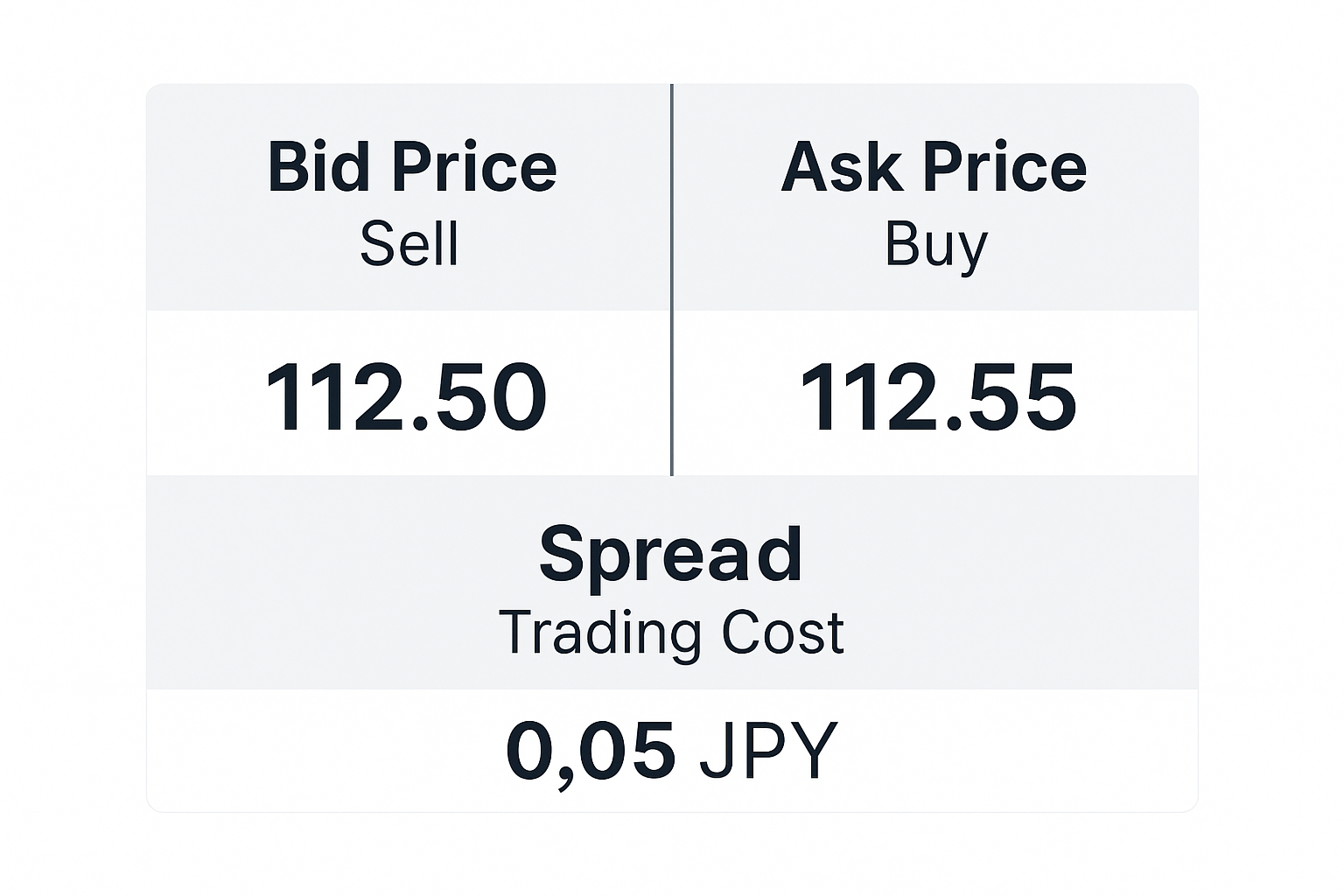
The spread is the difference between the bid price (sell) and the ask price (buy). It represents the cost of entering a trade.
For example, if USD/JPY has:
- Bid price: 112.50
- Ask price: 112.55
The spread is 0.05 JPY. When you open a trade, the price must move in your favour by at least the spread for the position to become profitable.
What factors affect forex spreads?
Several factors influence whether spreads are tight or wide:
- Liquidity: Highly traded pairs usually have tighter spreads.
- Volatility: Sudden market movements can cause spreads to widen.
- Time of day: Overlapping trading sessions often result in lower spreads.
- Trading conditions: Different account types and platforms may offer varying spreads.
Monitoring spreads is especially important for short-term traders, as costs can significantly impact results.
Deriv risk analyst: “Spreads are one of the most overlooked trading costs. Even small differences can materially affect outcomes, especially for frequent traders.”
How are forex pairs, pips, and spreads connected?
Forex pairs, pips, lot sizes, pip value, and spreads are all interconnected:
- Forex pairs define what you are trading.
- Pips measure how much the price moves.
- Lot size determines how large your exposure is.
- Pip value translates price movement into profit or loss.
- Spreads determine the cost of entering each trade.
Understanding how these elements work together supports clearer interpretation of trading costs and price movement.
How do beginners practise forex trading risk management strategies?
Before trading with real money, beginners can practise reading forex pairs and placing trades using a demo account choosing the right trading platform. Demo trading allows you to:
- Observe how different pairs behave
- Practise calculating pip value and trade size
- Understand how spreads affect trades
- Practise decision-making without using real funds
Using a structured approach to learning helps traders become more familiar with how trading mechanics work.
What should beginners understand about forex pairs?
Understanding forex pairs is a foundational step in learning how the forex market operates. By learning how pairs are structured, how prices move, and how key concepts such as pips and spreads affect trades, new traders can build a solid foundation. With practice, discipline, and continued learning, forex trading concepts become clearer over time as traders gain more exposure and experience.
Quiz
Which of these is a major forex pair?
FAQs


