Trading derivatives lets you access global markets without owning the underlying asset. On Deriv, you can do this through contracts for difference (CFDs) or options, each with distinct advantages.
In this guide, we compare CFDs and options in terms of structure, platforms, costs, and trading strategies so you can decide which suits your goals.
Quick summary
- CFDs offer flexibility and leverage, allowing you to open and close trades anytime — but losses can exceed your deposit if not managed carefully.
- Options have fixed expiries and capped losses, providing structured outcomes and clearer risk control for both short-term and long-term trades.
- CFDs are available on Deriv MT5 and Deriv cTrader; options are on Deriv Trader, Deriv Bot, and Deriv GO — so traders can choose tools suited to their style.
- A CFD’s payoff is linear. Leverage magnifies both profits and losses. Option payoffs vary: step-like for digital, changing slope at the strike for vanilla, or capped for multipliers.
Now that you know the basic differences, let’s look at how these products work on Deriv’s platforms.
What is the difference between CFDs and options on Deriv?
Let’s start by looking at how each product operates on Deriv’s dedicated platforms.
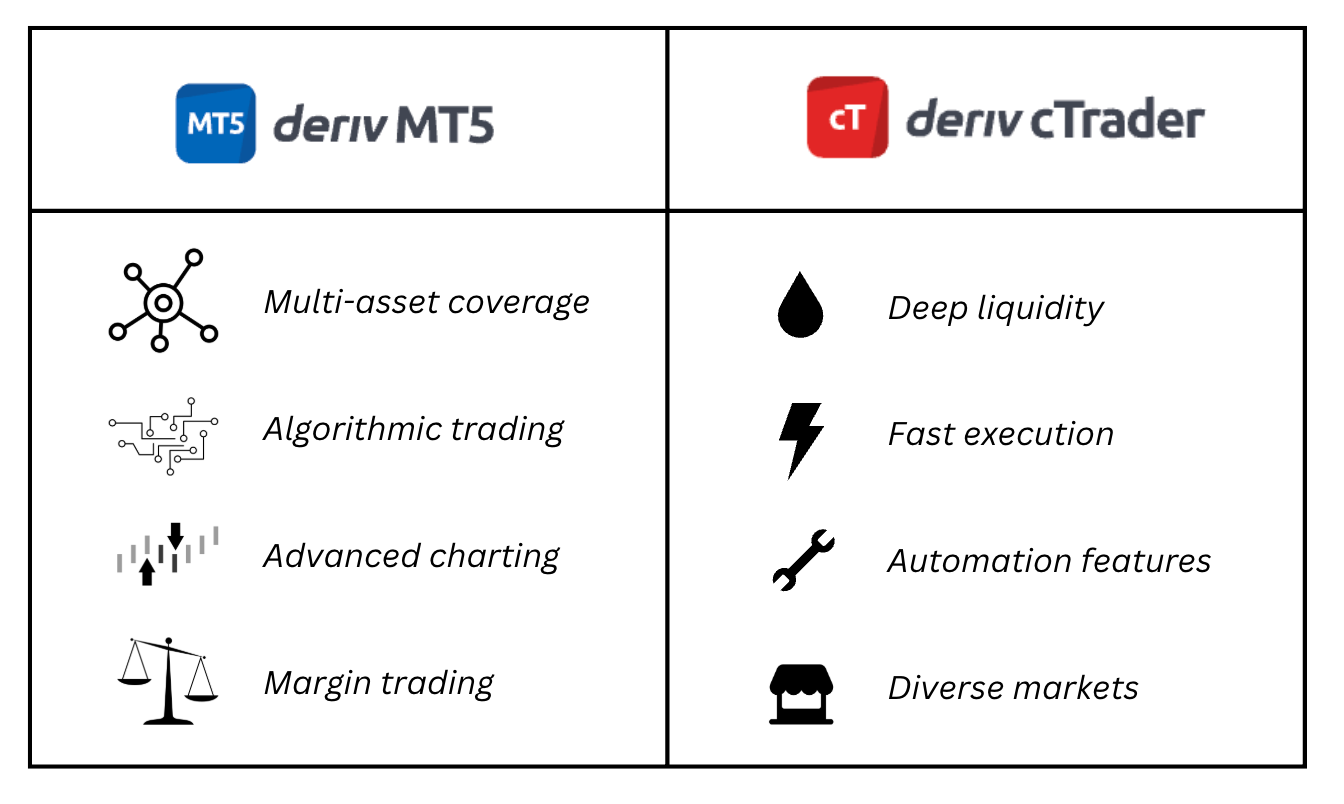
CFDs on Deriv MT5 and Deriv cTrader
These platforms are built for professional-grade trading. Both Deriv MT5 and Deriv cTrader offer multi-asset coverage, advanced charting, fast execution, and automation features supported by deep liquidity. They also support margin trading, diverse markets, and flexible risk management.
Example: A forex scalper on Deriv cTrader may execute dozens of short-term trades in a volatile pair.
Options on Deriv Trader, Deriv Bot, and Deriv GO
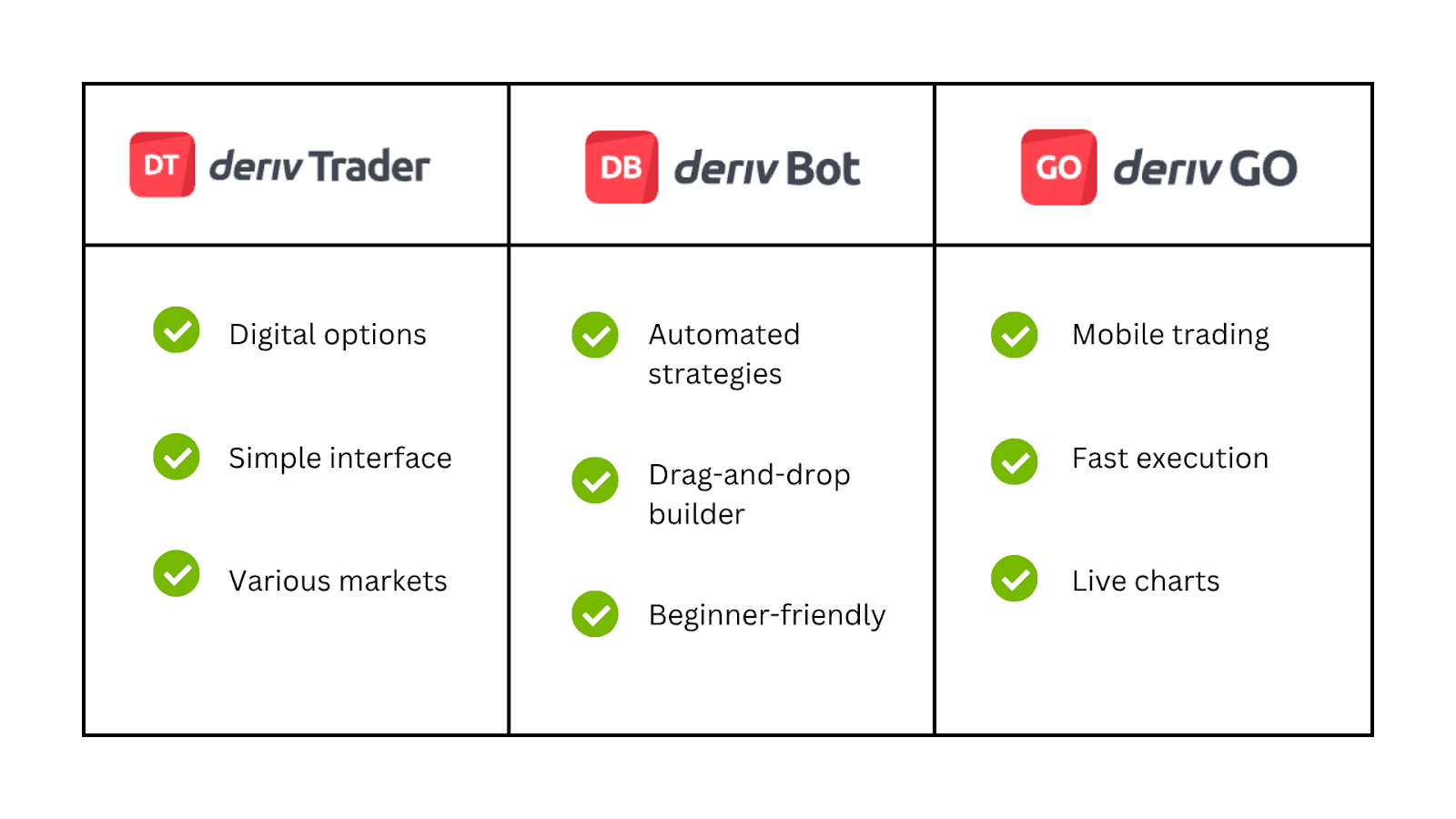
These platforms make options trading intuitive. Deriv Trader enables straightforward digital and turbo options. Deriv Bot automates strategies with drag-and-drop logic blocks, while Deriv GO enables quick mobile trading for fast-moving markets.
This separation lets traders focus on each product’s strengths while supporting transparency — in 2025 Deriv continues to align with best practices on margin reporting and client protection.
How do CFDs, options, and futures compare?
This comparison shows how CFDs prioritise flexibility and leverage, options emphasise predictability and capped risk, while futures focus on standardised contracts and long-term commitments — typically suited to institutional traders.
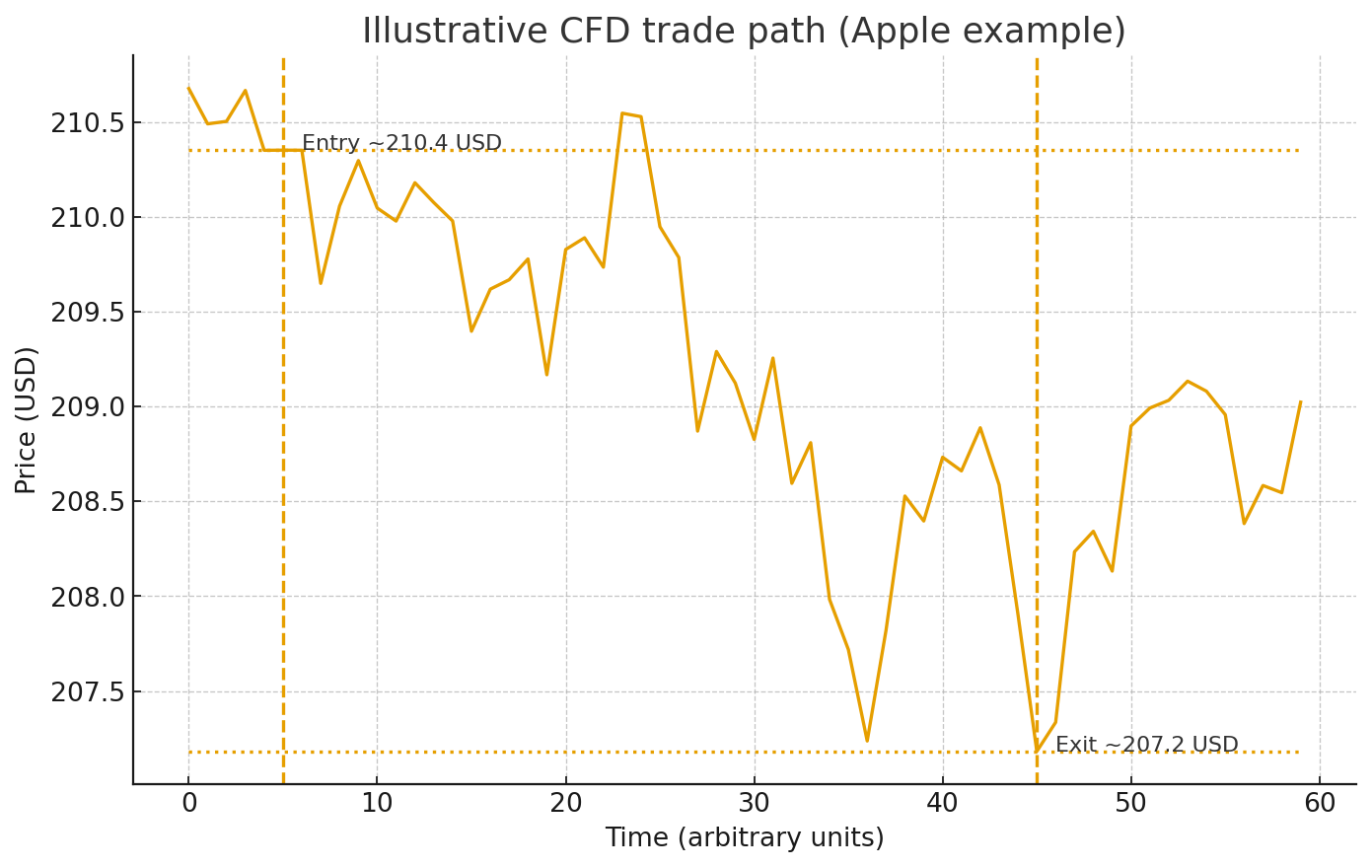
CFD example:
Buy 10 CFDs on Apple at 210 USD with 10% margin (deposit 210 USD).
- If Apple rises to 215 USD → profit 50 USD.
- If Apple falls to 205 USD → loss 50 USD.
Options example:
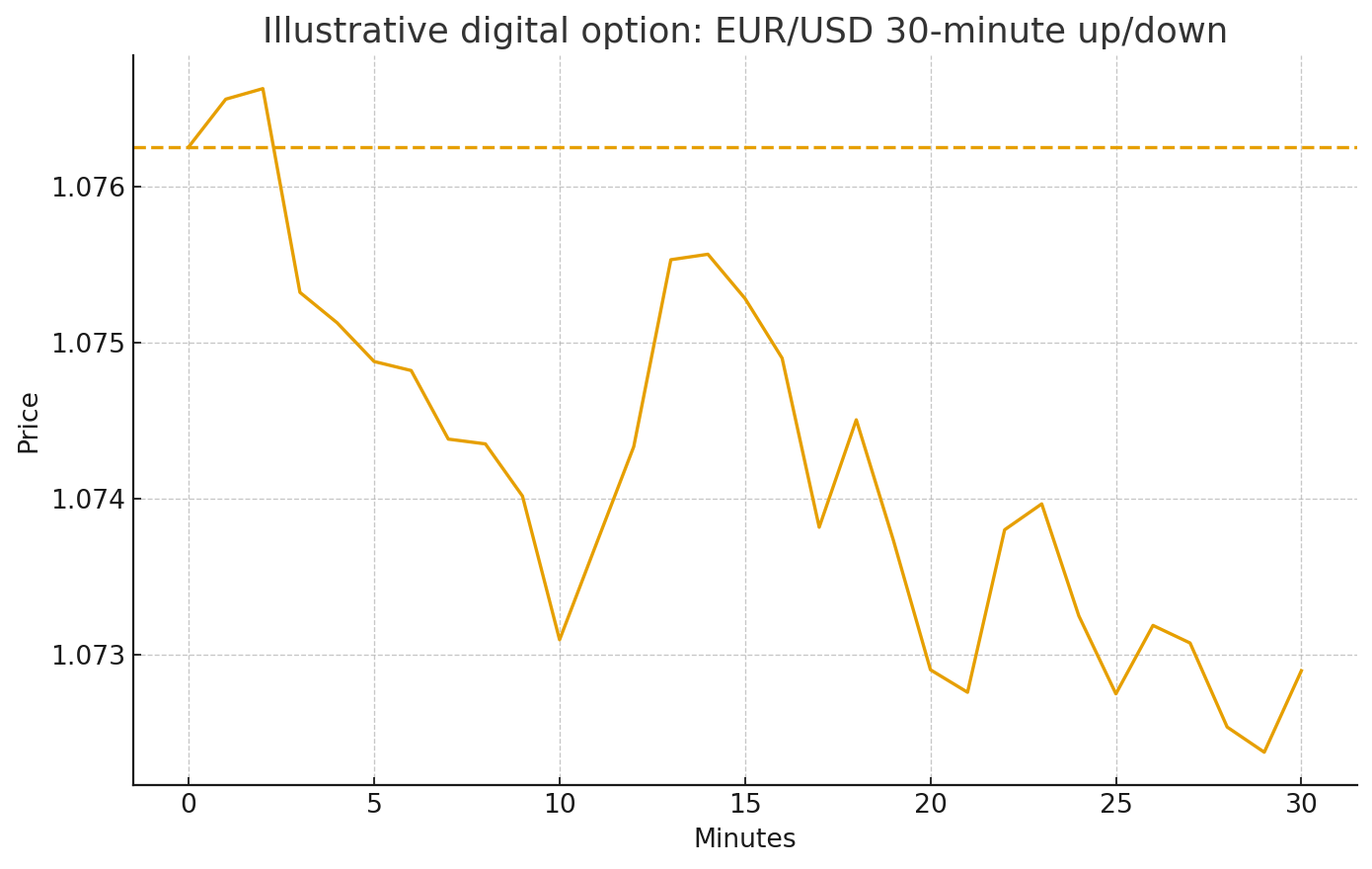
Buy a digital option on EUR/USD predicting a rise in 30 minutes.
- If correct → fixed payout (70–90%).
- If wrong → loss limited to initial stake.
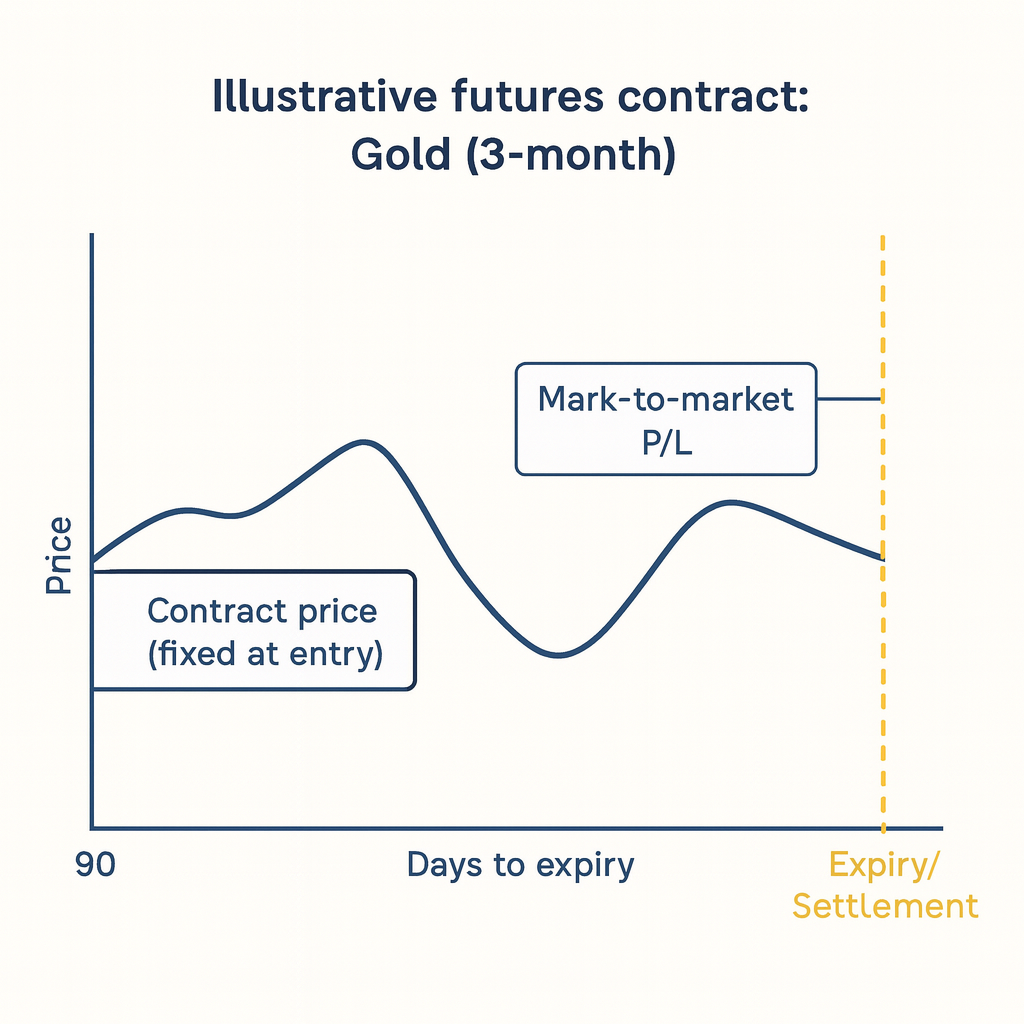
Futures example:
A gold futures contract obligates the trader to buy or sell gold at a fixed price on a future date.
- Profits or losses depend on the price difference between the contract entry and settlement.
- Futures often require higher capital and margin, making them less flexible for retail traders.
CFD traders use leverage for larger positions; options traders prefer predefined exposure.
These examples show how each product balances control, leverage, and risk.
What should you know about costs, funding, and practical considerations?
CFDs
- Spreads include costs; some assets may also have small commissions.
- Overnight financing (swap) can add charges or credits depending on position direction.
- Liquidity matters; fast markets may slip between order and fill.
- Equity CFDs can reflect dividends and corporate actions depending on position side.
Options
- The stake or premium is known upfront and represents maximum loss.
- Payouts depend on contract type; digital and turbo options pay fixed returns when conditions are met.
- Time sensitivity matters: time decay and volatility affect pricing, especially for vanilla options.
When comparing, consider the deposit, expected holding time, volatility, and whether you value flexibility (CFD) or predefined outcomes (option).
When should you choose CFDs or options?
Market conditions influence product choice:
- Volatility: CFD traders use leverage to profit from both rising and falling markets. Options traders use digital or turbo contracts to make rapid predictions with capped losses.
- Hedging: Some hedge CFDs with options — for example, a long CFD on the S&P 500 balanced by a put option.
- Regulation: Leverage restrictions make options attractive for beginners since losses are known in advance.
- Market trends: CFDs are suitable for bullish or active markets; options are suitable for uncertain conditions that require structured outcomes.
Muhammad Bilal Tariq, Deriv’s Product Owner, mentions:
“Retail traders are increasingly using both CFDs and options to balance risk and opportunity. CFDs provide flexibility, while options help structure exposure around volatility events.”
What trading strategies and risk management approaches work best for you?
CFD strategies
- Trend following: Use indicators like moving averages to ride directional moves.
- Range trading: Identify consolidation zones and trade reversions to the mean.
- Event trading: React to news releases using tight stops and limited exposure.
Options strategies
- Short-duration trades: Express quick directional opinions using digital or turbo contracts.
- Hedging: Protect open CFD positions with opposite options exposure.
- Time-based speculation: Align option expiry with forecasted events such as data releases.
According to Deriv Academy analysts:
“Traders who cap their exposure per position at 1–2% of account equity are better able to sustain their performance during volatile periods.”
Risk management tips
- Use stop-losses on CFDs and select appropriate expiry terms for options.
- Diversify across markets to balance exposure.
- Track performance through Deriv’s portfolio analytics tools.
Applying these techniques helps traders adapt to market shifts and maintain discipline across both CFDs and options.
How do futures compare to CFDs and options for retail traders?
Futures differ in structure, capital requirements, and flexibility, often suiting institutions more than retail traders.
- Structure: Futures bind buyers and sellers to a set price on a fixed date, while CFDs and options can be closed anytime.
- Capital: Futures demand larger deposits and standard contract sizes.
- Use cases: Institutions use futures to hedge commodities, rates, or indices, whereas CFDs and options are more accessible for retail use.
Deriv focuses on CFDs and options because they combine flexibility and defined-risk features preferred by individual traders.
How can you choose the right product for your strategy?
Your decision depends on how you balance opportunity and risk.
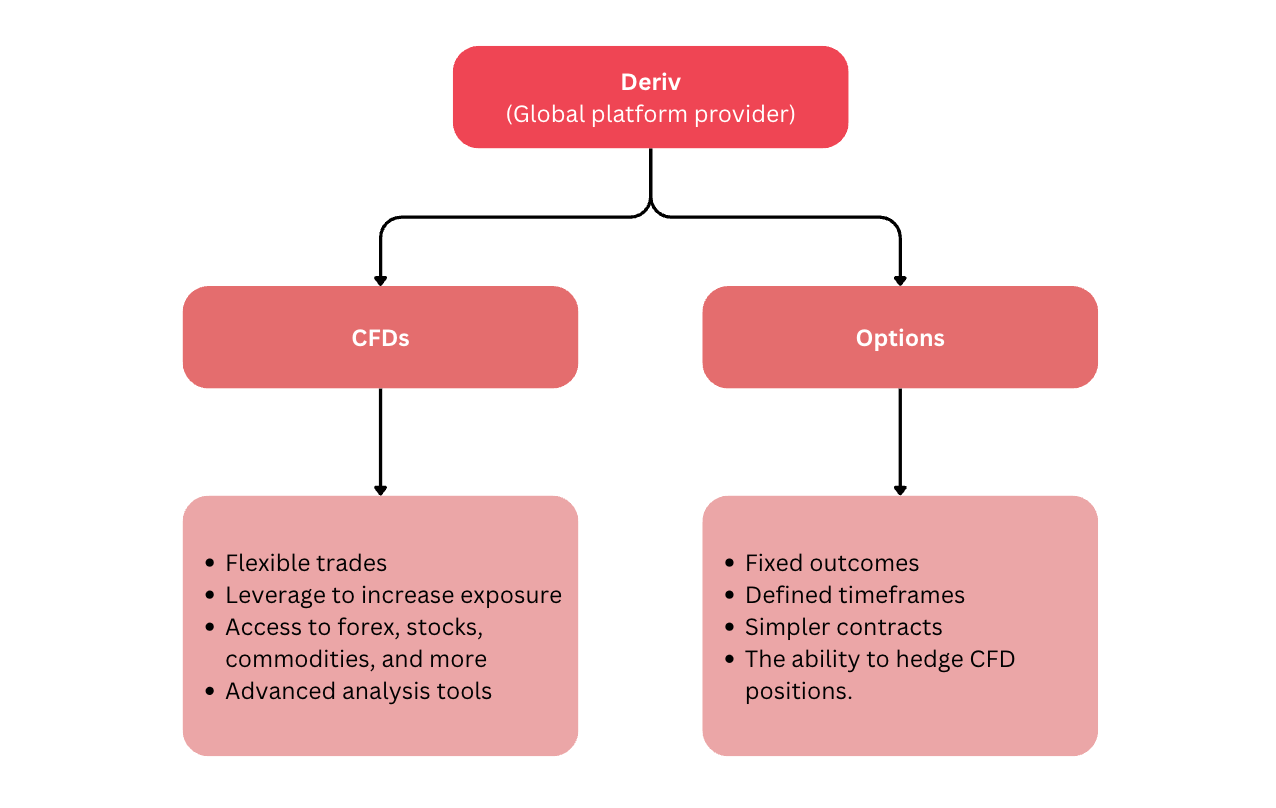
CFDs if you want:
- Flexible trades without expiry.
- Leverage to increase exposure with smaller deposits.
- Access to forex, stocks, commodities, cryptocurrencies, and derived indices.
- Advanced analysis tools and multi-strategy options.
Options if you prefer:
- Fixed outcomes with capped losses.
- Defined timeframes for structured trades.
- Simpler contracts without margin management.
- The ability to hedge CFD positions.
Deriv’s in-house experts note that traders combine these instruments to balance opportunity and protection:
“Retail traders are increasingly using both CFDs and options to balance risk and opportunity. CFDs provide flexibility, while options help structure exposure around volatility events.”
If you’re undecided, open a free Deriv demo account with 10,000 USD in virtual funds to test both products in real conditions.
What are the common pitfalls you should avoid?
- Over-leveraging: High leverage amplifies gains and losses; small moves can trigger large drawdowns.
- Ignoring time factors: Short expiries can invalidate otherwise correct trades.
- Chasing volatility: Sudden moves widen spreads and increase slippage; define risk and stay consistent.
- Neglecting costs: Overnight financing or option time decay can affect results.
- Skipping reviews: Keep a trade journal to refine strategy and discipline.
Avoiding these habits helps you preserve capital and perform sustainably.
Key takeaway
When comparing CFDs, options, and futures:
- CFDs: Flexibility and leverage.
- Options: Simplicity and capped risk.
- Futures: Institutional hedging, higher capital needs.
Your best choice depends on your objectives, risk tolerance, and preferred platform. Try both CFDs and options in a Deriv demo account to see which suits your trading approach.
Quiz
FAQs